

Introduction
The airline industry operates in one of the most volatile pricing environments across all sectors of global commerce. Fare structures shift multiple times daily, influenced by demand surges, competitor adjustments, seasonal booking windows, and route-specific market conditions. Automate Airline Pricing Reports Using APIs has emerged as the foundational approach for organizations seeking to maintain a reliable pulse on market pricing without the inefficiencies of manual monitoring.
Traditional fare tracking methods simply cannot match the velocity at which modern airline pricing evolves. Sky Airline API Scraping further enhances this capability by enabling structured, continuous data acquisition directly from live airline sources, empowering commercial teams with the speed and granularity needed for timely, confident fare strategy decisions across multiple routes and carriers.
This case study examines how a structured approach to automated fare intelligence transforms reporting workflows, improves pricing strategy precision, and enables meaningful competitive benchmarking. Airline Fare Data Extraction API for Travel Analytics plays a pivotal role in this transformation, allowing businesses to consolidate fare data from multiple sources into a unified analytical environment that supports faster, better-informed commercial outcomes.
The Client
A mid-sized travel technology company specializing in multi-carrier fare comparison tools approached our team with a clear objective: modernize their internal fare reporting infrastructure to support real-time competitive analysis across dozens of routes in key markets. Automate Airline Pricing Reports Using APIs was identified early in their strategic roadmap as the core capability required to close this operational gap.
The company served a diverse client base that included corporate travel managers, independent travel agencies, and direct-to-consumer booking platforms. Supporting these varied requirements through outdated infrastructure had become increasingly unsustainable. Flight Pricing Intelligence Data Services were evaluated as a solution pathway, given their ability to deliver structured, carrier-specific fare data with the consistency and refresh rates their clients required across different booking horizons.
Beyond data freshness, the client also required a system capable of detecting and flagging anomalous pricing events, including flash sales, sudden route repricing, and capacity-driven fare surges, in near real time. Real-Time Flight Ticket Price Tracking was positioned as an essential layer within the proposed solution, enabling the company to deliver proactive fare intelligence to their end clients rather than simply reporting on pricing changes that had already occurred.
The Challenge
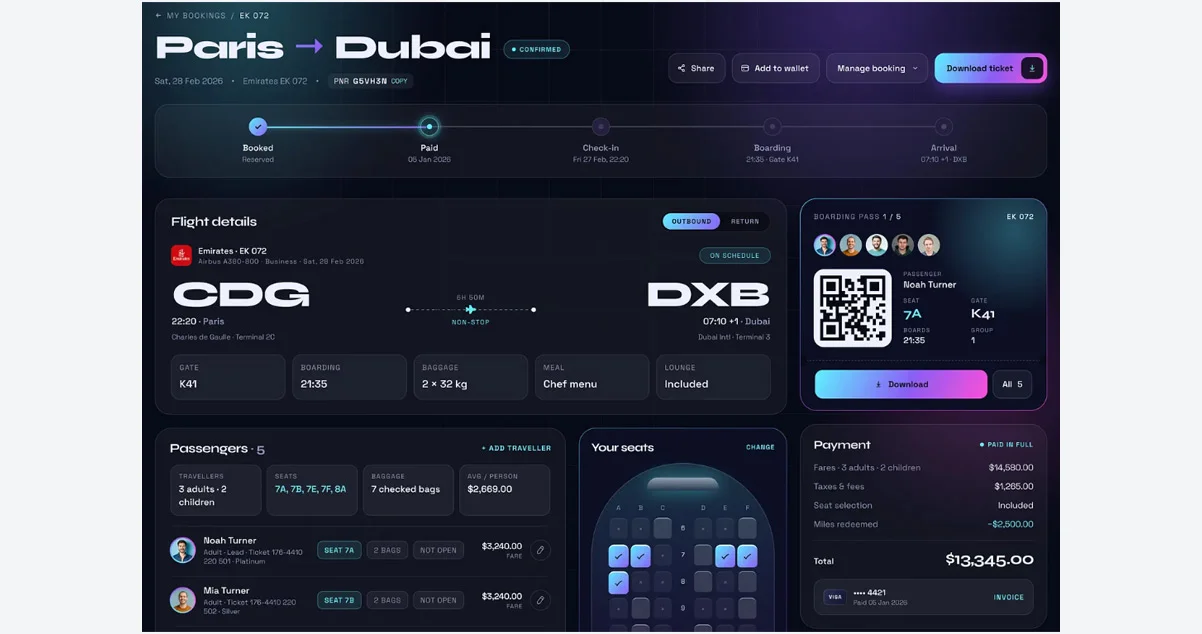
The client encountered a series of compounding operational difficulties that limited their ability to deliver reliable, timely fare intelligence to their downstream users.
Key issues included:
- Fare data arriving through disconnected feeds created significant inconsistencies in reporting outputs, making it difficult to produce accurate cross-carrier comparisons or meaningful trend analyses without time-consuming manual reconciliation across sources.
- Pricing updates on high-demand routes were frequently captured with delays ranging from several hours to over a day, reducing the commercial relevance of fare reports for clients making time-sensitive booking or procurement decisions.
- The absence of a structured anomaly detection layer meant that significant pricing events, including short-duration promotional fares and route-level repricing, regularly went undetected until after the pricing window had already closed for actionable response.
- Manual report generation consumed disproportionate analyst time, creating bottlenecks that prevented the team from scaling coverage to additional routes, carriers, or geographic markets without corresponding headcount increases.
These challenges collectively undermined the client’s ability to position itself as a high-value fare intelligence provider and limited its capacity to compete effectively against better-resourced market participants.
The Solution
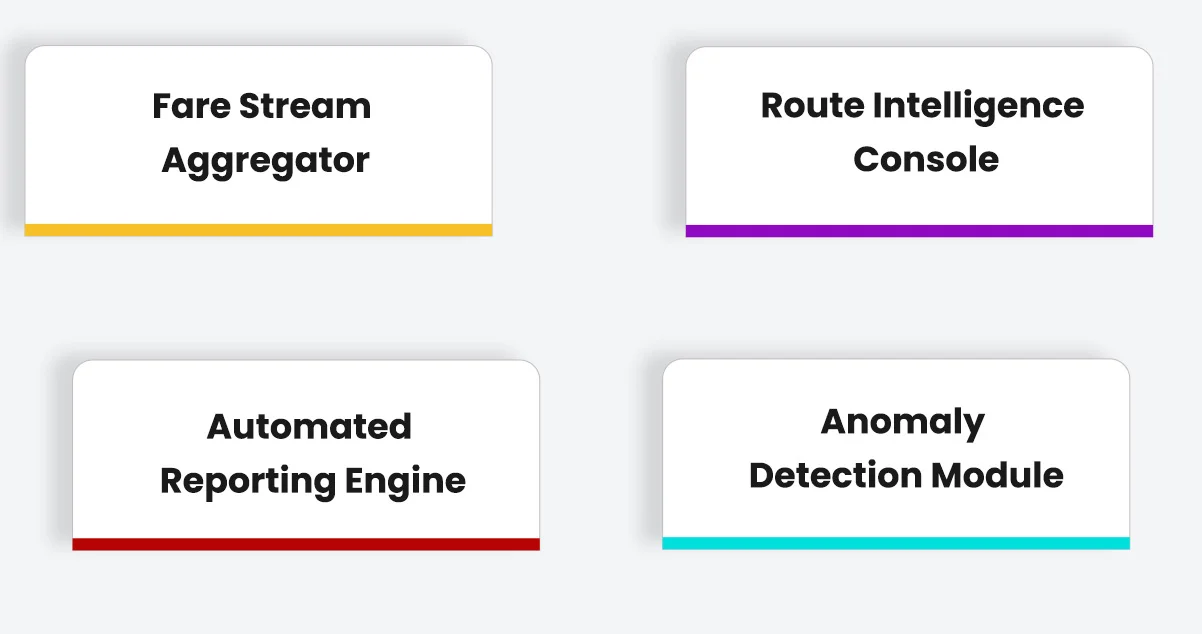
Our team developed a fully integrated, API-driven fare intelligence architecture designed to address each operational gap identified during the discovery phase.
- Fare Stream Aggregator
This engine normalized incoming data formats, resolved carrier-specific schema differences, and delivered clean, consolidated fare records into a unified data warehouse for downstream processing and analysis. - Route Intelligence Console
A purpose-built monitoring interface was configured to apply Scrape Airline Flight Data From Google Flights for Analysis methodologies alongside Travel Apps Scraping Services, combining publicly available fare signals with carrier-direct API data to produce comprehensive route-level pricing profiles. - Automated Reporting Engine
A scheduled and trigger-based reporting pipeline was deployed to replace all manual report generation workflows. Report templates were configured for each client segment, with outputs automatically generated at defined intervals or triggered by user-specified pricing thresholds, eliminating analyst dependency for routine fare report production. - Anomaly Detection Module
An intelligent alerting layer was integrated into the data pipeline to identify statistically significant fare deviations across monitored routes. Alert thresholds were configurable at the route, carrier, and cabin-class level, ensuring that commercial teams received timely notification of pricing events relevant to their specific market coverage areas.
Implementation Process
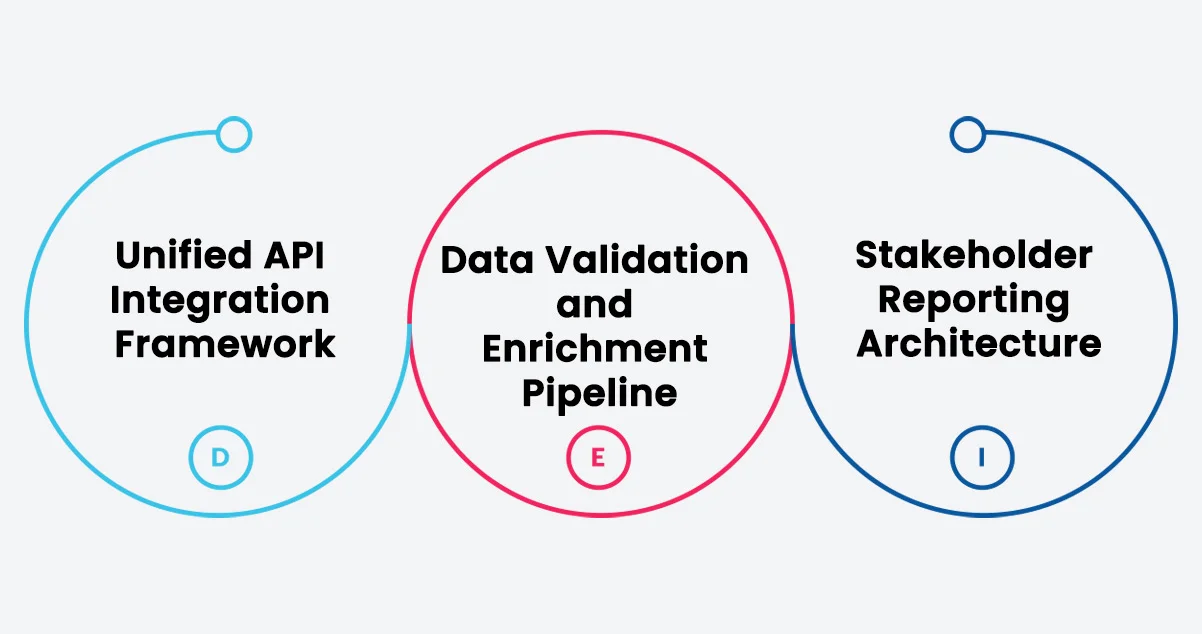
A structured, phase-driven deployment methodology was followed to ensure stability, accuracy, and seamless adoption across the client’s internal teams.
- Unified API Integration Framework
All carrier API connections and supplementary data sources were brought under a single integration management layer, enabling centralized credential management, rate-limit monitoring, and connection health visibility. Airline Fare Monitoring Using Web Scraping APIs protocols were incorporated within this framework to extend data coverage beyond API-exclusive sources and reduce single-source dependency risks. - Data Validation and Enrichment Pipeline
Every incoming fare record passed through a multi-stage validation workflow that checked for structural completeness, pricing anomalies relative to historical baselines, and carrier-source consistency. Enrichment steps appended route metadata, booking-window classifications, and seasonality tags to each fare record, significantly improving the analytical value of the output data. - Stakeholder Reporting Architecture
A tiered reporting structure was designed to align with the distinct data consumption needs of each client segment. Flight Pricing Intelligence Data Services standards were applied throughout the reporting layer to ensure that fare outputs met professional-grade accuracy and formatting requirements expected by corporate travel buyers and agency partners.
Results & Impact
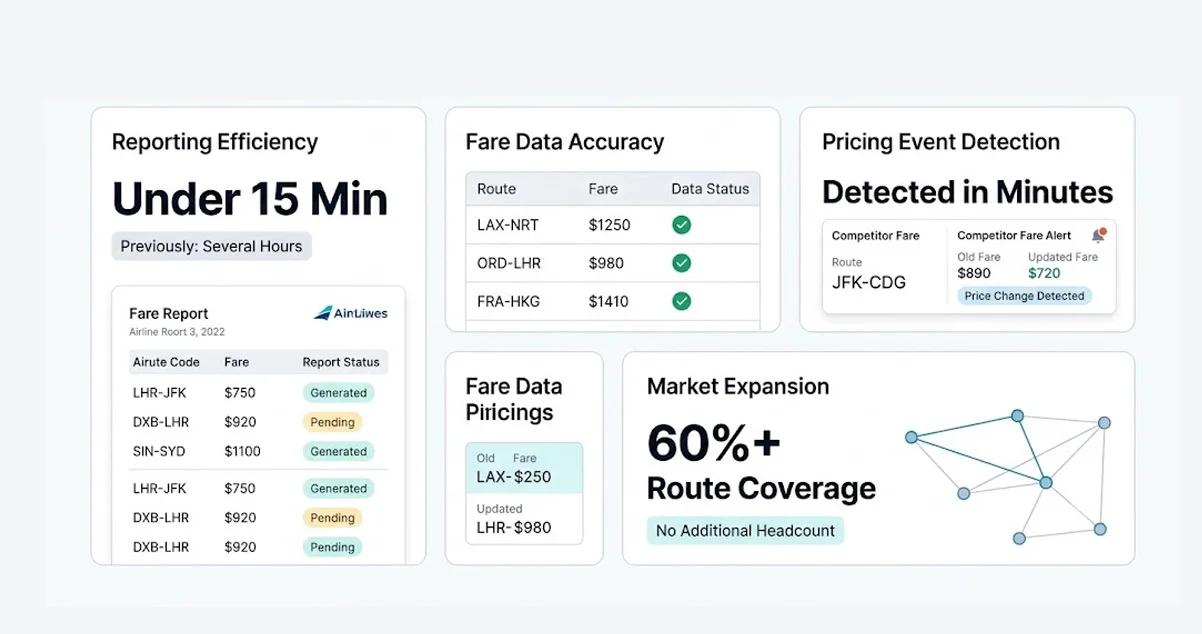
The implemented solution delivered measurable improvements across reporting efficiency, data quality, pricing strategy responsiveness, and analyst productivity.
- Reporting Efficiency Transformation
Automated fare report generation eliminated manual production cycles entirely, reducing report turnaround time from several hours to under fifteen minutes across all standard reporting templates and significantly freeing analyst capacity for higher-value strategic tasks. - Enhanced Fare Coverage Accuracy
Structured data validation and multi-source ingestion improved the accuracy and completeness of fare records across monitored routes, reducing data gaps and inconsistencies that had previously undermined the reliability of the client’s competitive pricing outputs. - Proactive Pricing Event Detection
The anomaly detection module successfully identified and flagged time-sensitive pricing events within minutes of their occurrence, enabling commercial teams to respond proactively to competitor fare movements and short-duration promotional windows that had previously gone undetected. - Scalable Market Expansion Capacity
With manual bottlenecks removed from the data acquisition and reporting workflows, the client expanded their monitored route coverage by over sixty percent without any increase in headcount, demonstrating the direct scalability impact of Automate Airline Pricing Reports Using APIs infrastructure on commercial growth capacity.
Key Highlights
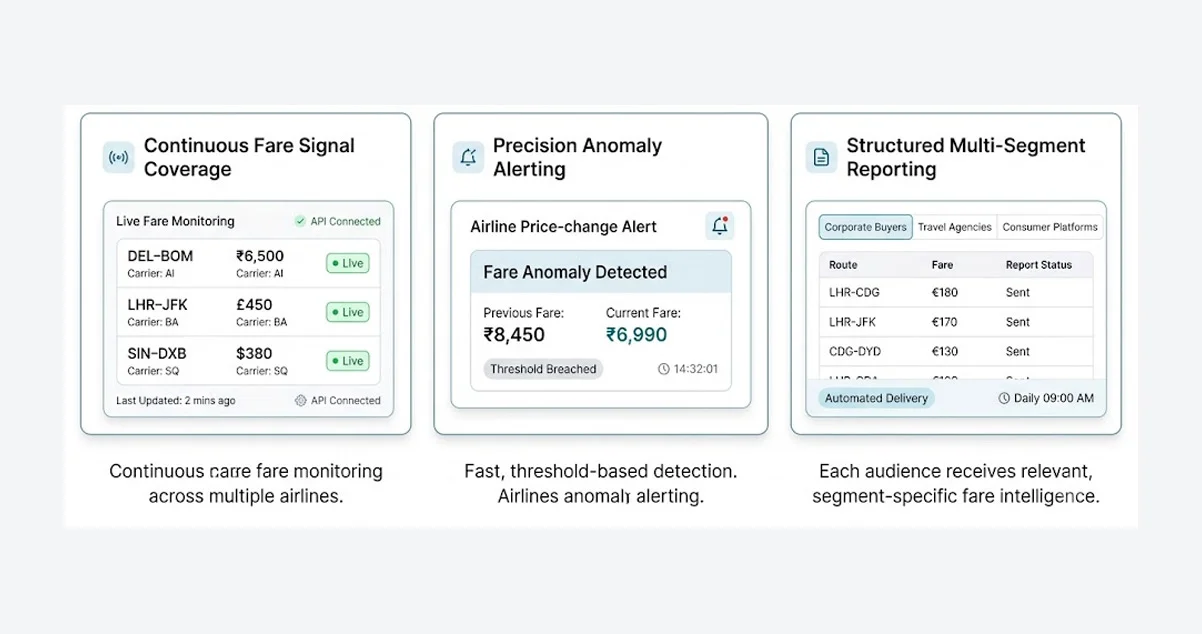
- Continuous Fare Signal Coverage
Delivers uninterrupted fare monitoring across multiple carriers and routes by combining API-driven data acquisition with supplementary web-based sources, ensuring that pricing intelligence remains current and commercially actionable at all times. Real-Time Flight Ticket Price Tracking capabilities anchor this continuous coverage model. - Precision Anomaly Alerting
Supports immediate commercial response to market pricing events through configurable threshold-based alerting, enabling teams to act on significant fare movements before competitors complete their own detection and response cycles. Airline Fare Monitoring Using Web Scraping APIs protocols enhance detection sensitivity across diverse source types. - Structured Multi-Segment Reporting
Delivers segment-specific fare reports tailored to the distinct analytical requirements of corporate buyers, independent agencies, and consumer-facing platforms, with automated scheduling and threshold-triggered delivery ensuring that each audience receives relevant, timely pricing intelligence without manual intervention.
Use Cases
Strengthen your fare intelligence operations with structured, API-driven data capabilities designed to support a range of strategic and operational applications.
- Competitive Pricing Strategy
Revenue management teams can apply continuous carrier-level fare monitoring to evaluate competitor pricing posture across key routes, informing dynamic pricing adjustments that maintain competitiveness without sacrificing yield management objectives. - Demand Pattern and Booking Horizon Analysis
Planning and analytics teams can utilize Travel Datasets alongside historical fare records to map the relationship between booking lead times, demand fluctuations, and fare movement patterns, enabling more accurate demand forecasting and capacity pricing strategies for future schedule periods. - Agency and Corporate Client Intelligence
Account managers serving travel agency and corporate travel buyer segments can deliver structured, route-specific fare reports that demonstrate pricing value, support negotiation positions, and strengthen long-term client retention through consistent, high-quality market intelligence delivery. - New Route Viability Assessment
Market development teams can evaluate fare dynamics on prospective new routes by analyzing competitor pricing depth, demand seasonality indicators, and historical pricing volatility, reducing the commercial uncertainty associated with new route launches and capacity deployment decisions.
Client's Testimonial

Partnering with the Mobile App Scraping team to Automate Airline Pricing Reports Using APIs has fundamentally changed how we approach fare intelligence. The impact on our team’s capacity and our clients’ confidence in our data has been significant. Real-Time Flight Ticket Price Tracking capabilities in particular have given us a genuine competitive edge in detecting and responding to pricing events faster than we ever thought possible.
– Marcus Delrey, Head of Fare Analytics, TravelTech Ventures
Conclusion
The airline pricing landscape will only grow more complex as carriers refine their revenue management systems and competitive fare activity intensifies across global markets. Automate Airline Pricing Reports Using APIs represents the clearest path forward for travel technology firms, airlines, and agencies seeking to build durable fare intelligence capabilities that scale with market complexity rather than strain under it.
Contact Mobile App Scraping today to learn how our specialized API-driven fare intelligence solutions can transform your pricing operations. Airline Fare Data Extraction API for Travel Analytics enables organizations to consolidate diverse pricing signals into unified, analytically rich environments that support faster decisions and stronger competitive positioning across every market segment they serve.