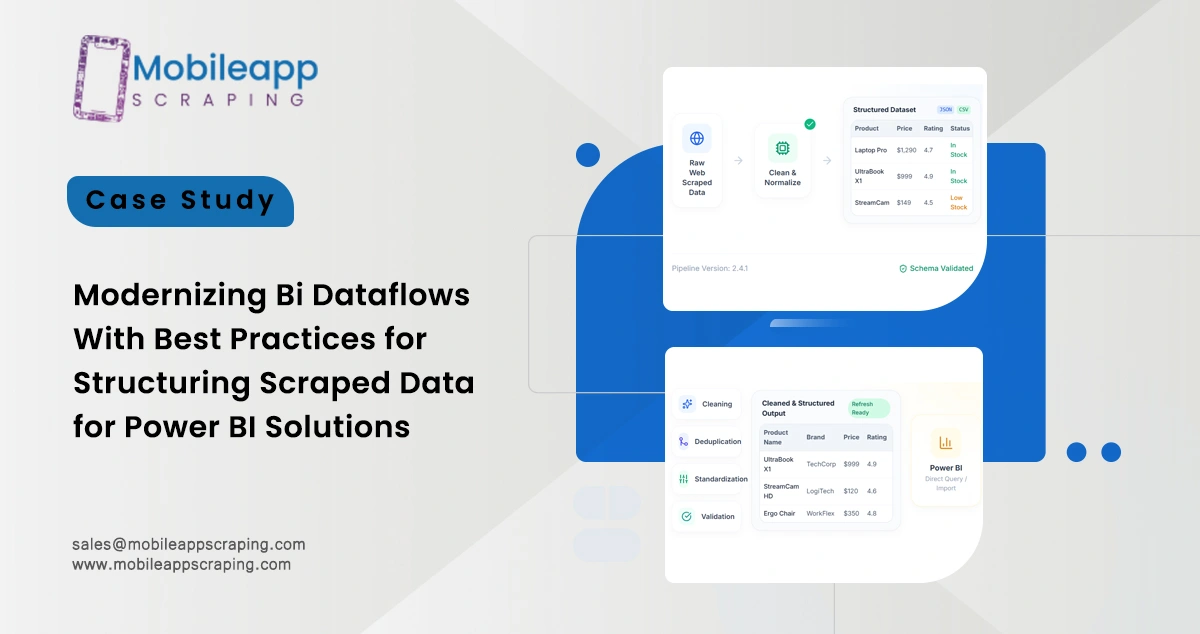
Introduction
Modern business intelligence depends less on gut instinct and more on structured, reliable data pipelines that consistently deliver clean inputs. Organizations investing in Best Practices for Structuring Scraped Data for Power BI are seeing measurable improvements in dashboard accuracy, stakeholder confidence, and reporting speed. API Scraping plays a foundational role in automating data collection from dynamic sources and feeding it into structured BI workflows with minimal friction.
Enterprises today operate across fragmented digital ecosystems where data arrives in inconsistent formats from mobile applications, competitor platforms, and third-party services. Applying Web Scraping Power BI and Tableau for Data Analytics allows analysts to consolidate these scattered inputs into unified datasets that serve both strategic planning and operational reporting. The absence of a structured data ingestion process often results in delayed insights and flawed decision-making rooted in unreliable information.
This case study examines how a forward-thinking analytics firm partnered with Mobile App Scraping to modernize its BI dataflows. Through deliberate pipeline design, intelligent data transformation workflows, and targeted scraping methodologies, the client achieved measurable improvements in report reliability and cross-functional intelligence. The outcome reflects the tangible value of treating data structure as a strategic asset rather than an afterthought.
The Client
A mid-sized retail analytics consultancy serving multiple consumer goods brands approached Mobile App Scraping to address persistent gaps in its Power BI reporting infrastructure. Their existing data pipelines were patched together using manual exports and inconsistently formatted spreadsheets that frequently caused dashboard errors. Applying Best Practices for Structuring Scraped Data for Power BI became a central pillar of their modernization roadmap.
The consultancy worked with clients spanning grocery retail, apparel, and consumer electronics, making standardized data ingestion particularly challenging. Each vertical demanded different schema structures and update frequencies, and the firm lacked a unified approach to normalize scraped inputs before loading them into Power BI. Integrating Data Cleaning and Transformation for Power BI via Scraping into their workflows was identified as the most critical intervention needed to stabilize reporting accuracy across their diverse client portfolio.
Beyond Power BI, the consultancy also maintained Tableau dashboards for a subset of clients who preferred that visualization environment. This dual-platform requirement made Structuring Mobile App Scraped Data for Tableau equally important alongside their Power BI objectives. The firm needed one cohesive data architecture capable of serving both environments without duplicating transformation logic or maintaining separate pipelines for each tool.
The Challenge
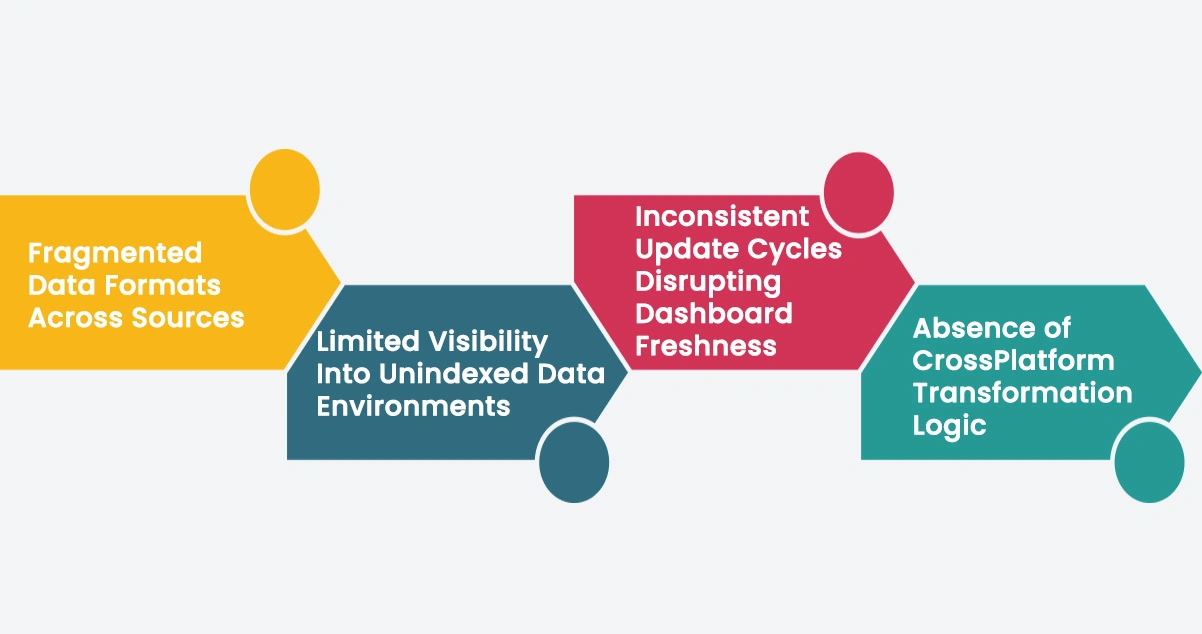
The consultancy encountered several deeply rooted operational challenges that undermined the reliability of its BI outputs and frustrated both internal analysts and end clients.
- Fragmented Data Formats Across Sources
Data arriving from mobile app scraping operations carried inconsistent column naming conventions, mismatched date formats, and mixed data types that made direct loading into Power BI unreliable. Each source introduced structural noise that cascaded into broken visuals and inaccurate aggregations downstream. - Limited Visibility Into Unindexed Data Environments
Certain competitive intelligence requirements pushed the consultancy into challenging data environments that conventional scraping tools could not reliably access. Deep and Dark Web Scraping introduced additional complexity in terms of data normalization since outputs from these sources rarely conformed to predictable schemas, requiring custom parsing logic before any transformation could begin. - Inconsistent Update Cycles Disrupting Dashboard Freshness
The firm had no standardized refresh mechanism to ensure that Power BI dashboards reflected current market conditions. Manual intervention was frequently needed to reconcile stale data with live inputs, eroding analyst productivity and delaying client deliverables during high-stakes reporting cycles. - Absence of Cross-Platform Transformation Logic
Because the consultancy served both Power BI and Tableau users, every new data source required duplicated cleaning and transformation work. Without a shared logic layer, errors introduced in one environment often went undetected in the other, creating inconsistencies that damaged stakeholder trust over time.
The Solution
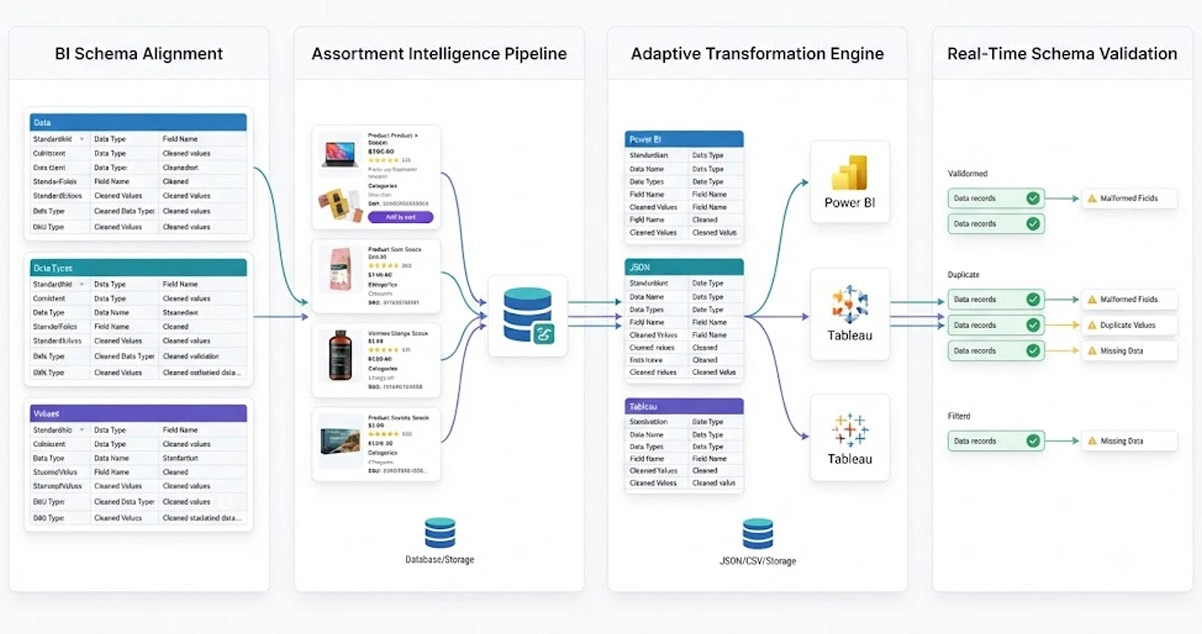
We designed a structured, multi-layered solution that addressed each challenge through purpose-built tools and intelligent data architecture.
- BI Schema Alignment Framework
This framework enabled Clean and Structure Web Scraped Data for Power BI at the point of entry, ensuring consistent column types, naming conventions, and null-value handling regardless of source complexity. - Assortment Intelligence Pipeline
A dedicated pipeline was built around Assortment Analytics Data Scraping to capture product catalog data across multiple retail platforms and transform it into structured datasets aligned with the consultancy's reporting dimensions. - Adaptive Transformation Engine
An intelligent middleware layer was developed to execute Data Transformation of Web Scraped Data for Tableau and Power BI simultaneously. This engine applied format-specific output rules depending on the destination platform, eliminating the need to maintain separate transformation scripts and significantly reducing the risk of cross-platform data discrepancies. - Real-Time Schema Validation Module
A validation checkpoint was embedded directly into the pipeline to flag structural anomalies before data reached visualization layers. This component ensured that only schema-compliant records advanced through the pipeline, reducing dashboard errors and shortening the time analysts spent troubleshooting data quality issues.
Implementation Process
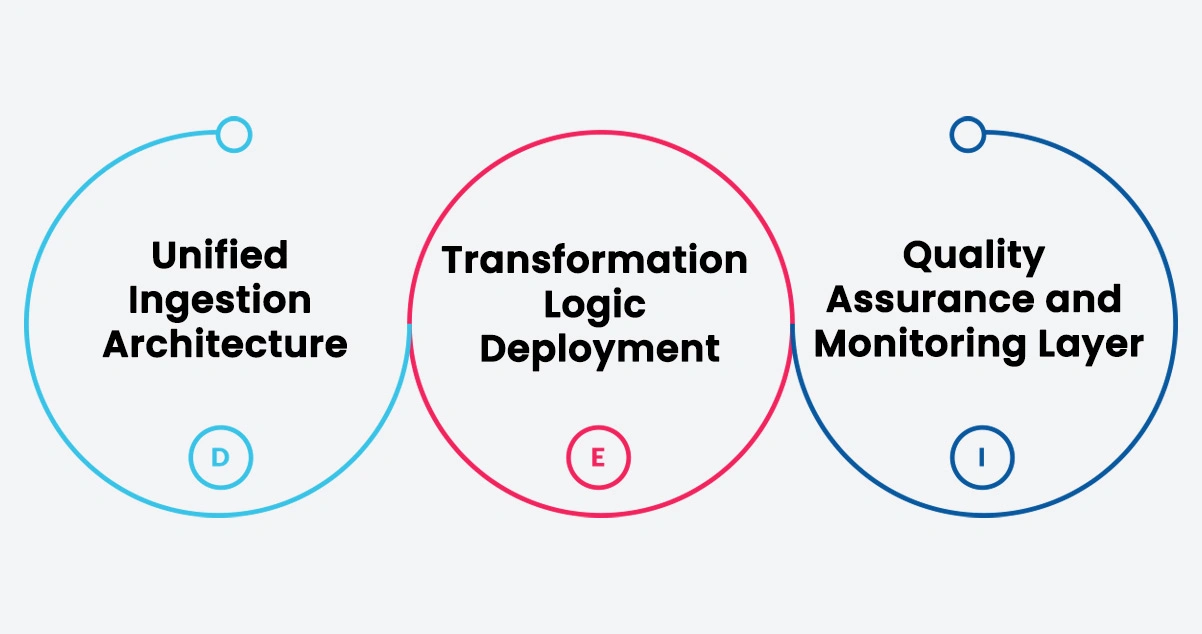
Mobile App Scraping executed the solution rollout across structured phases designed to minimize disruption to the consultancy's active client reporting cycles.
- Unified Ingestion Architecture
This architecture supported Web Scraping Power BI and Tableau for Data Analytics by creating a single structured input stream that both platforms could consume without additional manual preparation. - Transformation Logic Deployment
The system applied Data Transformation of Web Scraped Data for Tableau and Power BI logic conditionally based on destination flags, ensuring that each platform received data in its optimal format without redundant processing steps. - Quality Assurance and Monitoring Layer
Anomaly alerts were configured to notify analysts of structural deviations before they propagated into live dashboards, supporting sustained adherence to Data Cleaning and Transformation for Power BI via Scraping standards throughout ongoing operations.
Results & Impact
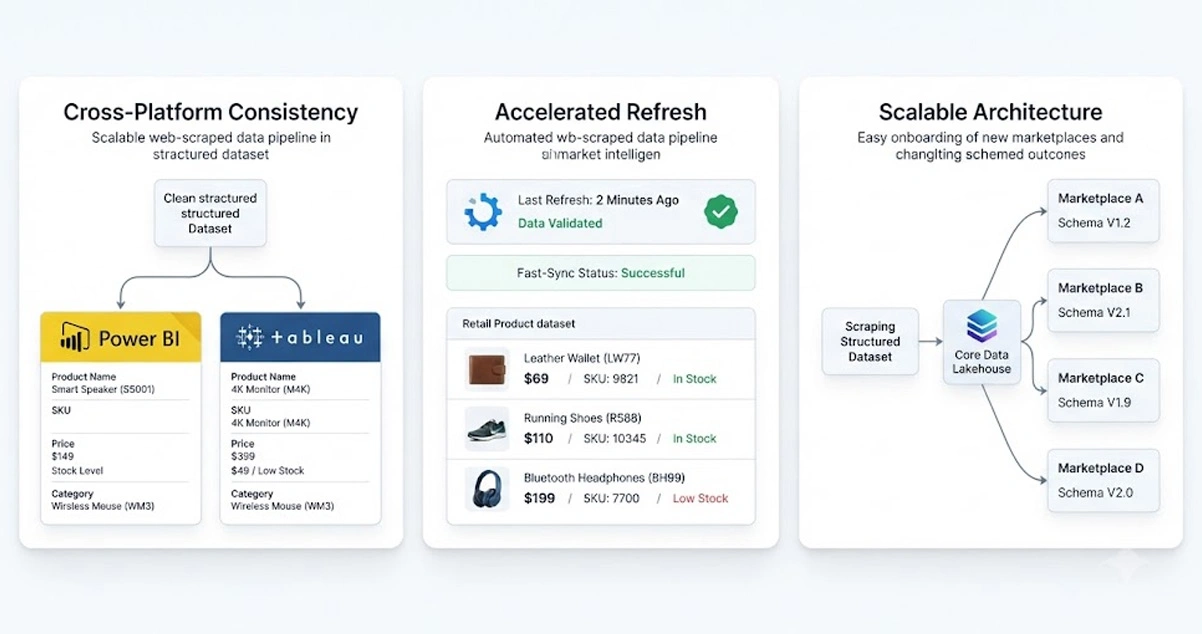
The engagement delivered measurable improvements across data quality, operational efficiency, and client-facing reporting reliability.
- Cross-Platform Reporting Consistency
By implementing unified transformation logic, the consultancy achieved consistent outputs across both Power BI and Tableau environments. Clean and Structure Web Scraped Data for Power BI protocols ensured that the same underlying dataset produced equivalent visual outputs in both tools, restoring stakeholder confidence in multi-platform reporting. - Accelerated Refresh Cycles
Automated ingestion and real-time validation reduced dashboard refresh latency considerably. The consultancy's clients received more timely market intelligence, enabling faster pricing decisions and more responsive inventory adjustments during competitive retail periods. - Scalable Data Architecture
The pipeline design accommodated the onboarding of new data sources without requiring structural redesign. As client requirements expanded, the framework absorbed additional scraping targets and schema variations smoothly, supporting long-term growth without proportional increases in technical overhead.
Key Highlights
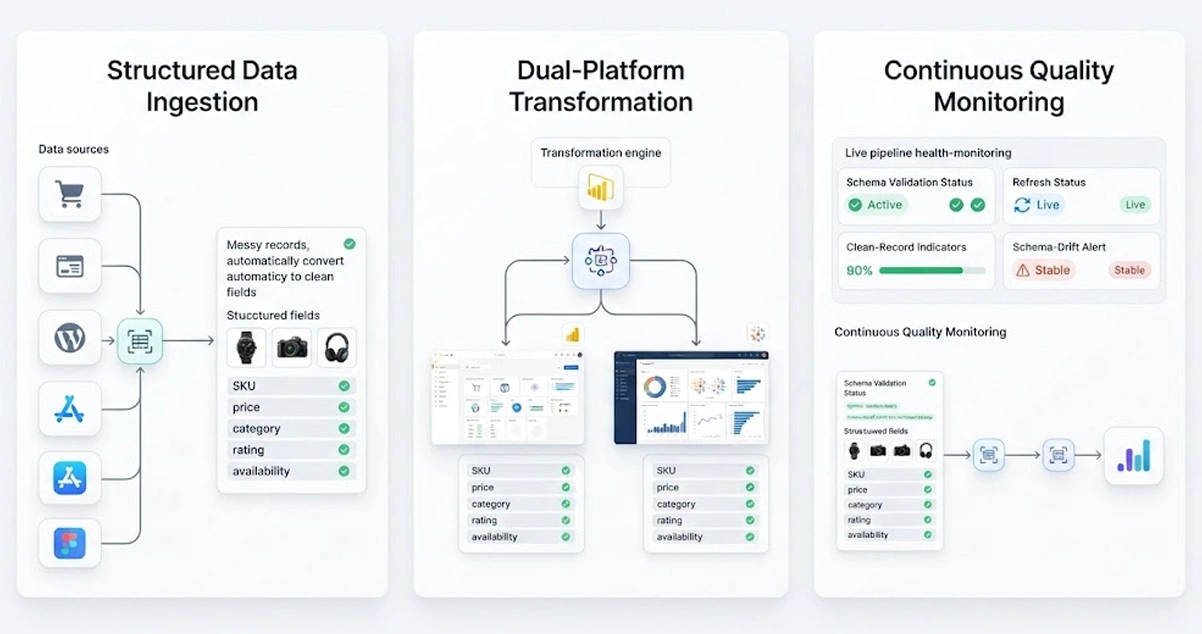
- Structured Data Ingestion
Implements end-to-end schema alignment and validation to ensure that every scraped input meets quality standards before reaching Power BI or Tableau, supporting Best Practices for Structuring Scraped Data for Power BI across diverse data sources and client environments. - Dual-Platform Transformation
Delivers adaptive transformation logic that simultaneously prepares data for both Power BI and Tableau, reducing redundancy and enabling Structuring Mobile App Scraped Data for Tableau alongside Power BI workflows through a single unified processing layer. - Continuous Quality Monitoring
Maintains real-time pipeline health checks and schema drift detection to sustain data integrity across refresh cycles, ensuring that Web Scraping Power BI and Tableau for Data Analytics operations consistently produce clean, structured, and dashboard-ready outputs.
Use Cases
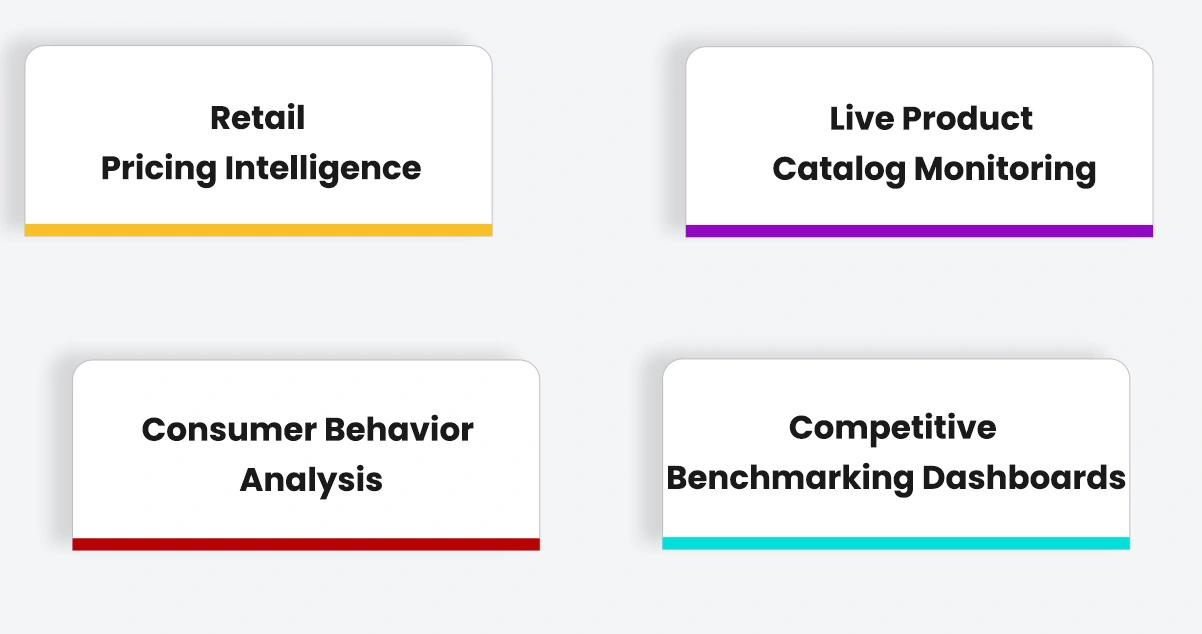
Our data structuring and transformation capabilities support a wide range of strategic applications across analytics, retail, and business intelligence functions.
- Retail Pricing Intelligence
Analytics teams can extract competitor pricing data from mobile applications and e-commerce platforms, structure it through validated ingestion pipelines, and load it directly into Power BI dashboards for real-time market positioning analysis and dynamic pricing strategy support. - Live Product Catalog Monitoring
Live Crawler Data Scraping enables continuous tracking of product availability, SKU changes, and catalog updates across retail platforms. Structured outputs feed directly into Tableau and Power BI environments, giving category managers instant visibility into assortment gaps and competitive product movements without manual data compilation. - Consumer Behavior Analysis
Structured behavioral data extracted from mobile apps and digital platforms can be transformed and loaded into BI tools to reveal regional purchasing patterns, feature adoption trends, and engagement metrics that inform both product development and marketing investment decisions. - Competitive Benchmarking Dashboards
Organizations can build automated benchmarking pipelines that collect, clean, and structure competitor data at scale. Applying Data Cleaning and Transformation for Power BI via Scraping standards ensures that benchmarking dashboards remain accurate, refreshed, and ready to support strategic planning discussions with minimal analyst intervention.
Client's Testimonial

Working with Mobile App Scraping fundamentally changed how our team approaches data preparation. Before this engagement, our analysts spent hours each week chasing schema errors and reconciling inconsistent inputs. Their expertise in Best Practices for Structuring Scraped Data for Power BI gave us exactly the operational foundation we needed. The Structuring Mobile App Scraped Data for Tableau capabilities they built alongside it were an added advantage that we didn't initially expect to benefit from as much as we did.
– Marcus Elwood, Head of Analytics Operations
Conclusion
In an environment where data volume is expanding faster than most organizations can manage, having a disciplined approach to pipeline design is no longer optional. Applying Best Practices for Structuring Scraped Data for Power BI enables analytics teams to move from reactive troubleshooting to proactive intelligence delivery.
Contact Mobile App Scraping today to discover how our data structuring and transformation services can modernize your BI dataflows. Clean and Structure Web Scraped Data for Power BI practices reduce the friction between raw data collection and meaningful visualization, helping businesses make faster and more confident decisions from their BI investments.