

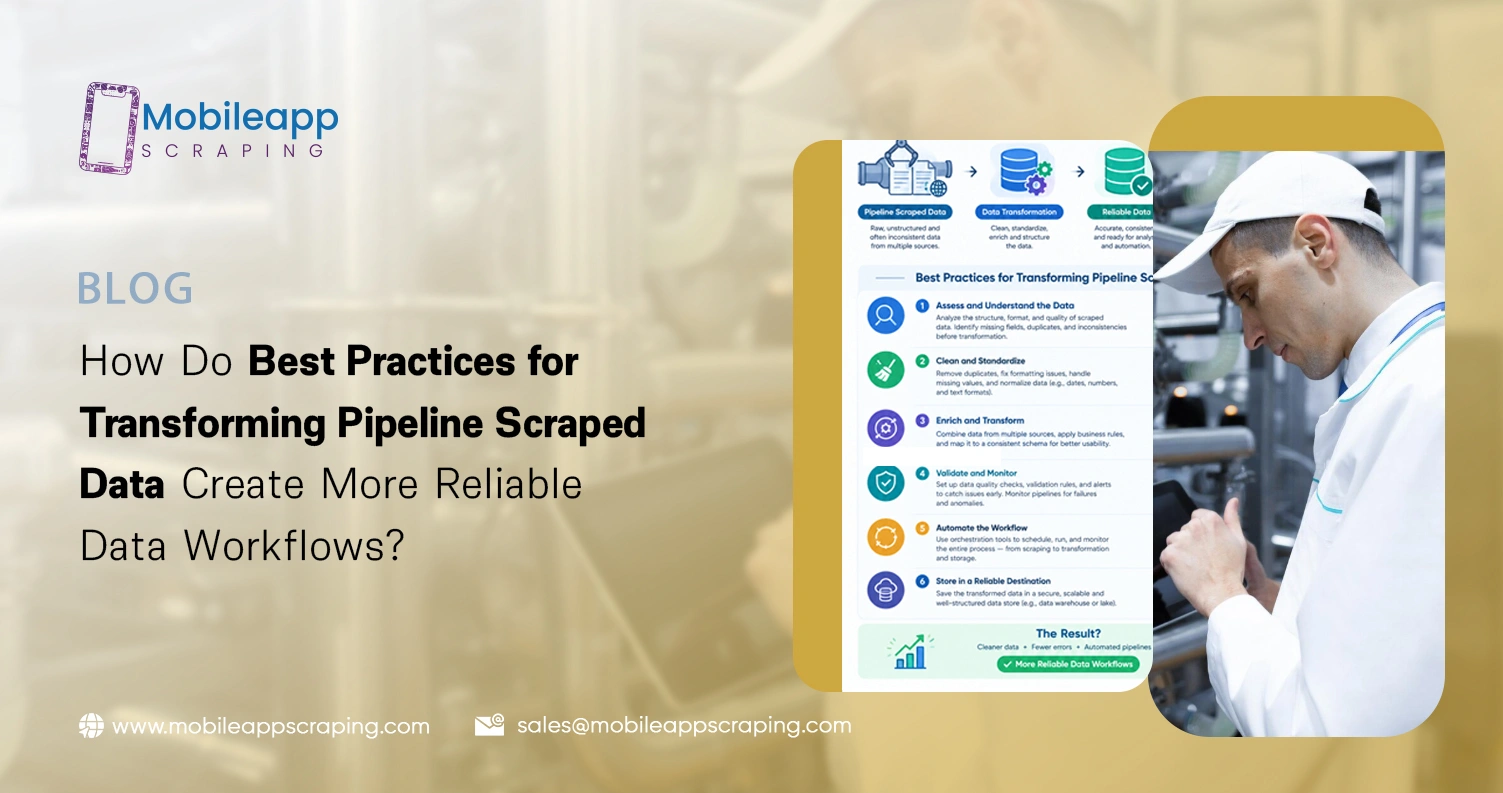
How Do Best Practices for Transforming Pipeline Scraped Data Create More Reliable Data Workflows?
Introduction
Modern businesses collect massive volumes of information from websites and applications, but raw scraped records often contain duplicates, inconsistent formats, missing values, and irrelevant fields. Applying Best Practices for Transforming Pipeline Scraped Data helps organizations convert fragmented records into structured datasets that support dependable reporting and analytics.
Effective transformation also creates stronger connections between collection, processing, validation, and storage. Organizations using Web Scraping Services can establish systematic workflows that reduce manual corrections while improving data consistency across multiple sources. Well-designed processes make datasets easier to maintain as collection volumes and business requirements increase.
Reliable transformation is particularly important when scraped information feeds pricing, market research, product intelligence, customer analysis, or operational dashboards. Standardized processing rules improve downstream usability while reducing errors that can affect decisions. The right approach combines validation, normalization, deduplication, enrichment, and quality monitoring throughout the workflow.
Strategic Foundations That Make Scraped Data Processing More Reliable

A dependable transformation workflow begins with clearly defined schemas, field structures, validation rules, and processing stages. When organizations focus on Building a Data Transformation Pipeline for Scraped Data, they can create repeatable processes for handling information gathered from different websites and applications. A structured approach reduces inconsistencies before records reach databases or analytical platforms.
Each incoming record should pass through predetermined checks for missing values, incorrect formats, duplicate entries, and unexpected fields. This becomes especially important when a Mobile App Scraper collects information from applications that may organize product, pricing, availability, or review data differently. Standardized mapping rules ensure that similar information follows the same structure regardless of its original source.
A strong foundation also requires documented transformation logic that teams can review and update as source structures evolve. Maintaining clear rules makes troubleshooting easier and helps technical teams identify where inaccurate records entered the workflow. It also creates greater transparency when multiple departments depend on the same transformed datasets.
Key practices include:
- Defining standardized schemas before processing
- Establishing field-level validation rules
- Removing duplicate records systematically
- Mapping inconsistent fields into common structures
- Documenting transformation and exception-handling rules
| Practice | Workflow Benefit |
|---|---|
| Schema definition | Creates consistent fields |
| Data validation | Reduces inaccurate records |
| Deduplication | Removes repeated entries |
| Field mapping | Aligns different sources |
Creating these foundations makes transformation more predictable and easier to scale. Instead of repeatedly correcting datasets after collection, organizations can introduce quality controls directly into the workflow, reducing downstream errors and creating cleaner information for reporting and business analysis.
Precision Driven Controls That Strengthen Data Quality Across Workflows

Transformation quality depends on continuous controls rather than occasional data cleanup. Organizations can apply Data Normalization Techniques for Scraped Data to standardize names, measurements, currencies, categories, timestamps, and other fields collected from different sources. Consistency at this stage prevents incompatible records from creating problems during analysis or reporting.
Continuous collection environments also require transformation workflows capable of handling frequent updates. With Live Crawler Data Scraping, newly collected records can move through automated validation, normalization, and quality checks before being stored. This helps organizations maintain fresher datasets while reducing the possibility of outdated or malformed information entering downstream systems.
Quality controls should monitor missing fields, unusual values, duplicate records, failed transformations, and unexpected structural changes. Automated alerts can notify teams when predefined thresholds are exceeded, allowing issues to be addressed before they influence dashboards or analytical models.
Useful controls include:
- Standardizing values across different sources
- Checking records against defined data rules
- Monitoring unexpected field changes
- Flagging abnormal values automatically
- Reviewing recurring transformation failures
| Quality Control | Primary Purpose |
|---|---|
| Normalization | Standardizes collected information |
| Validation | Detects incorrect records |
| Duplicate checking | Limits repeated entries |
| Monitoring | Identifies workflow problems |
Consistent controls improve confidence in transformed information while making ongoing maintenance easier. Rather than depending entirely on manual inspection, organizations can combine automated checks with periodic reviews to maintain reliable datasets throughout continuous collection and processing cycles.
Future Ready Architectures Built To Handle Expanding Data Demands

Growing data volumes require workflows that can process additional records without creating unnecessary delays or operational bottlenecks. Organizations implementing Scalable Data Transformation Pipelines for Web Scraping can structure processing stages to accommodate higher collection volumes while maintaining consistent validation and transformation standards across expanding datasets.
Application-derived information can also become more valuable when integrated with broader business datasets. Using App Data Scraping Services alongside centralized transformation processes allows organizations to bring information from multiple application environments into a consistent analytical structure. This creates opportunities to compare datasets while maintaining standardized processing rules.
Flexible architecture should rely on modular components so individual stages can be modified without rebuilding the complete workflow. Automated testing, resource management, performance monitoring, and error handling can further improve operational stability. These capabilities become increasingly important when organizations add new sources, categories, regions, or collection frequencies.
Important scalability practices include:
- Separating workflows into manageable processing stages
- Automating repetitive transformation operations
- Monitoring processing speed and resource usage
- Testing new transformation rules before deployment
- Designing workflows for additional data sources
| Architecture Practice | Expected Outcome |
|---|---|
| Modular processing | Easier workflow expansion |
| Automated testing | Faster quality verification |
| Resource management | Better processing efficiency |
| Performance monitoring | Earlier bottleneck detection |
A flexible architecture enables transformation workflows to evolve alongside business requirements. By combining modular processing with automated quality controls, organizations can support larger datasets without sacrificing consistency, accuracy, or operational reliability across their analytical environment.
How Mobile App Scraping Can Help You?
Mobile applications generate valuable information across products, services, prices, availability, ratings, and customer-facing experiences. When combined with Best Practices for Transforming Pipeline Scraped Data, application records can move through standardized validation, cleaning, normalization, and enrichment stages before reaching analytical systems.
Mobile-derived information can support several operational and analytical requirements:
- Centralizing information from multiple application sources
- Reducing repetitive manual data preparation activities
- Improving consistency across collected records
- Supporting faster updates for changing information
- Creating structured datasets for analytics and reporting
- Improving visibility across operational data workflows
These capabilities help organizations maintain cleaner datasets while supporting frequent collection cycles. Consistent processing rules can further support Transforming Raw Scraped Data Into Actionable Insights by preparing reliable records for practical business applications.
When mobile information is processed through clearly defined workflows, teams can reduce inconsistencies between collection sources and improve the usability of resulting datasets. This creates a more dependable foundation for organizations that continuously process application-based information.
Conclusion
Reliable data workflows depend on more than collecting large volumes of information. Organizations need structured processing, validation, normalization, deduplication, monitoring, and scalable architecture to ensure collected records remain useful. Applying Best Practices for Transforming Pipeline Scraped Data creates a stronger foundation for accurate analytics, reporting, and operational decision-making across changing data environments.
A well-managed workflow also improves long-term efficiency by reducing repetitive cleanup and making transformation rules easier to maintain. An ETL Pipeline for Scraped Web Data can connect collection and processing stages while supporting consistent movement into analytical environments. Build more reliable data workflows with Mobile App Scraping and transformation solutions tailored to your business needs.