Introduction
The grocery retail sector is evolving rapidly, and businesses that rely on static pricing data risk falling behind in a market where consumer decisions shift daily. Grocery Price Data Extraction Using Web Scraping APIs has emerged as a foundational strategy for retailers, comparison platforms, and market analysts who need precise, real-time product data to stay competitive.
Modern price comparison tools demand more than occasional data snapshots; they require continuous, reliable feeds that reflect live shelf conditions across hundreds of stores simultaneously. Grocery Price Monitoring Using Web Scraping enables businesses to capture these fluctuating price signals at scale, offering a measurable advantage in planning, positioning, and product strategy.
This case study outlines how our team delivered a fully integrated data extraction framework for a grocery comparison business through industry-leading Grocery App Scraping Services. By building structured pipelines tailored to the client's operational requirements, we helped them unlock a new level of accuracy, speed, and market responsiveness transforming how they approach pricing intelligence and product catalog management across diverse retail chains.
The Client
A fast-growing digital retail analytics firm focused on building consumer-facing grocery comparison tools approached us with a clear objective: establish a dependable, high-frequency data pipeline capable of feeding their platform with accurate pricing information across major supermarket chains. They needed a partner who understood both the technical depth of extraction work and the commercial urgency of their situation.
The firm operated across multiple metropolitan markets, serving both individual consumers and enterprise clients who relied on their platform for procurement planning and competitive benchmarking. Integrating Grocery Price Data Extraction Using Web Scraping APIs into their core infrastructure was a necessary step toward building a product that could genuinely compete with established comparison platforms. Grocery Price Tracking App Using Web Scraping capabilities were central to their product vision from the very beginning.
To support their long-term roadmap, the client also needed tools that could adapt to new grocery chains, evolving website structures, and shifting regulatory considerations without significant re-engineering each time. Grocery Product Catalog Scraping for Market Analysis was identified as a key capability gap, one that, once resolved, would allow their team to expand market coverage without proportionally scaling internal development resources.
The Challenge
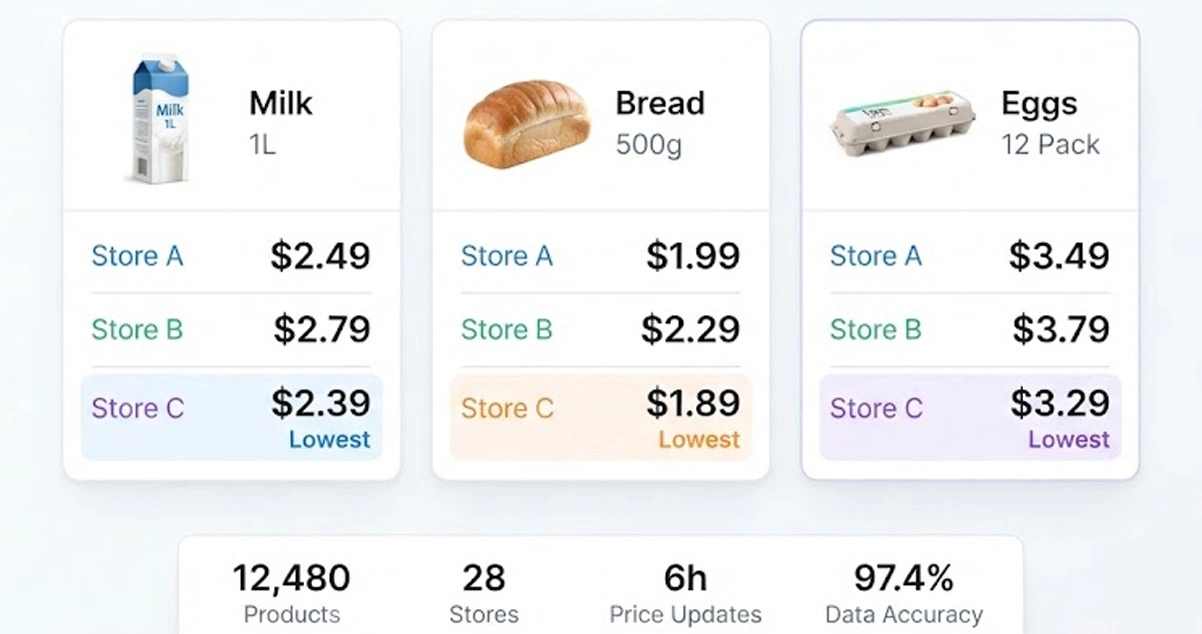
The client encountered several deeply rooted operational barriers that limited their ability to build a reliable, scalable grocery price comparison platform.
- Frequent Website Structure Changes
Grocery websites across major chains frequently update their site structures, breaking existing scrapers and causing significant data gaps that disrupt the client's ability to maintain consistent product listings and accurate pricing feeds essential for their platform users. - Fragmented Extraction Architecture
The absence of a centralized extraction architecture meant that teams were managing dozens of fragmented scripts with no unified monitoring or failover logic, making it impossible to apply a Price Optimization Service approach to pricing strategy or deliver standardized insights across retailer datasets. - Latency in Data Updates
Real-time data requirements conflicted sharply with the client's legacy batch-processing approach, which introduced hours of latency into data updates and left users comparing prices based on figures that no longer reflected what was available at checkout eroding trust in the platform over time. - Disproportionate Scaling Effort
Scaling to new retail chains required disproportionate engineering effort, as there was no modular extraction framework in place. Each new grocery source demanded a custom-built scraper, consuming development bandwidth that could otherwise support product and feature growth.
These interconnected challenges collectively undermined the client's ability to deliver a trustworthy, competitive grocery price comparison experience at the scale their business goals required.
The Solution
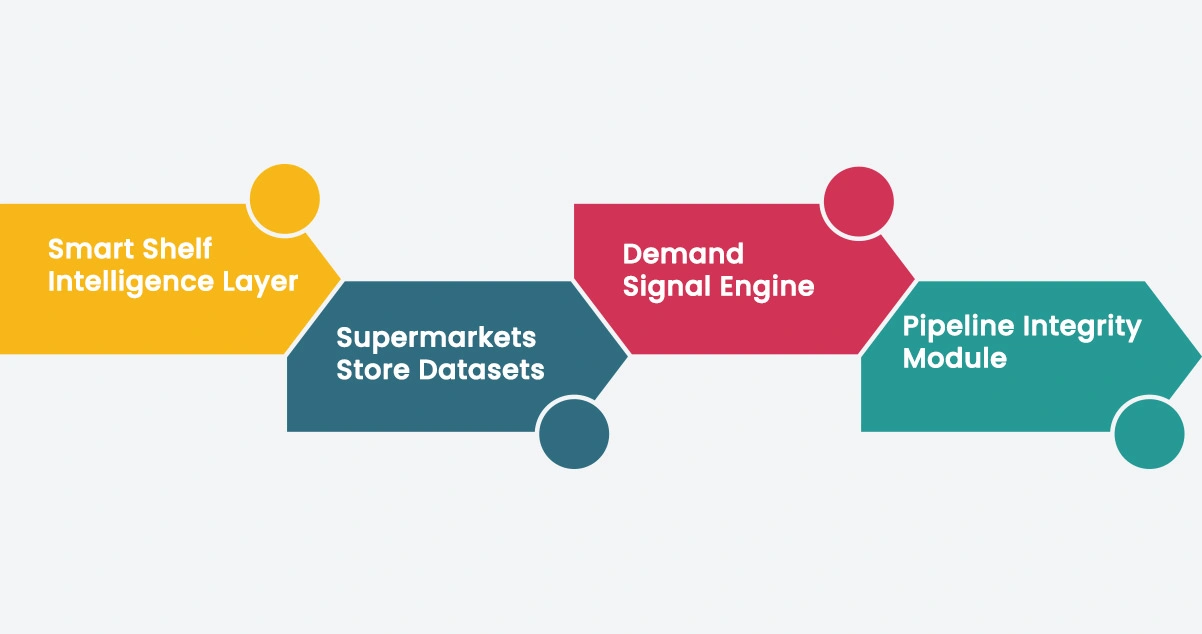
Our team designed a modular, high-performance data extraction ecosystem that addressed each of the client's core challenges with precision-built components.
- Smart Shelf Intelligence Layer
A dynamic extraction layer built to Collect Grocery Product Prices Using Web Scraping APIs from dozens of major grocery chains simultaneously, with built-in adaptive parsing that accommodates site structure changes without requiring manual intervention or scraper rebuilds between update cycles. - Supermarkets Store Datasets
This enabled the client's platform to generate consistent comparison results across multiple retail sources, regardless of differences in data structures or update frequencies. The integration of Grocery Supermarkets Store Datasets further strengthened backend stability and improved the reliability of comparison outputs. - Demand Signal Engine
An intelligent trend layer that continuously processes incoming product data to surface pricing patterns, discount cycles, and stock behavior giving the client's analytics team a clear view of market movement that could directly inform Grocery Price Comparison API for Businesses integrations for enterprise clients. - Pipeline Integrity Module
A fault-tolerant monitoring and recovery system that ensures uninterrupted data flow, automatically flagging anomalies, rerouting failed extraction jobs, and maintaining audit logs for compliance and quality assurance across all active grocery data sources at any given time.
Implementation Process
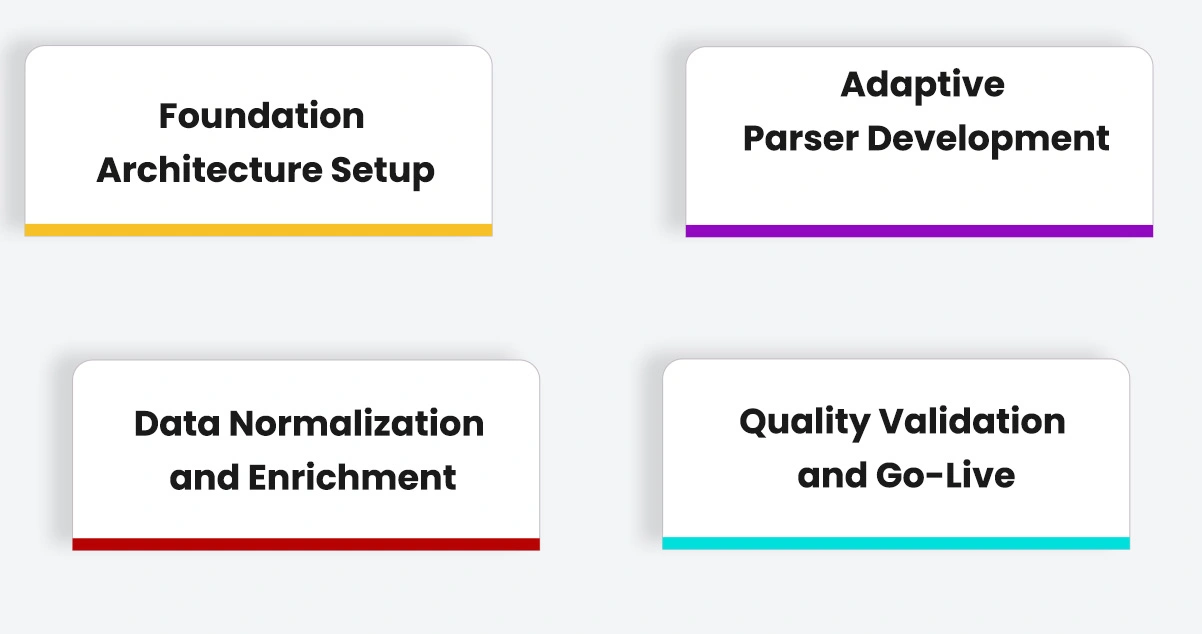
Our delivery team followed a structured, phase-driven approach to ensure every component of the extraction system was production-ready before full deployment.
- Foundation Architecture Setup
We established a cloud-native extraction infrastructure capable of supporting high-frequency data pulls, designed with redundancy and horizontal scalability from the outset to accommodate the client's growth trajectory without architectural rework. - Adaptive Parser Development
Custom parsers were built and tested against live grocery retailer environments, incorporating self-healing logic to handle DOM changes and ensure the system could Collect Grocery Product Prices Using Web Scraping APIs reliably across structurally diverse e-commerce platforms. - Data Normalization and Enrichment
Raw extracted data was passed through a multi-stage cleaning and enrichment pipeline, aligning product identifiers, unit measurements, and pricing formats into a unified schema compatible with the client's comparison platform and Grocery Price Monitoring Using Web Scraping reporting modules. - Quality Validation and Go-Live
Before full deployment, every data source underwent rigorous validation testing, with accuracy benchmarks checked against manually verified pricing snapshots. Only sources meeting defined quality thresholds were promoted to the live production pipeline.
Results & Impact
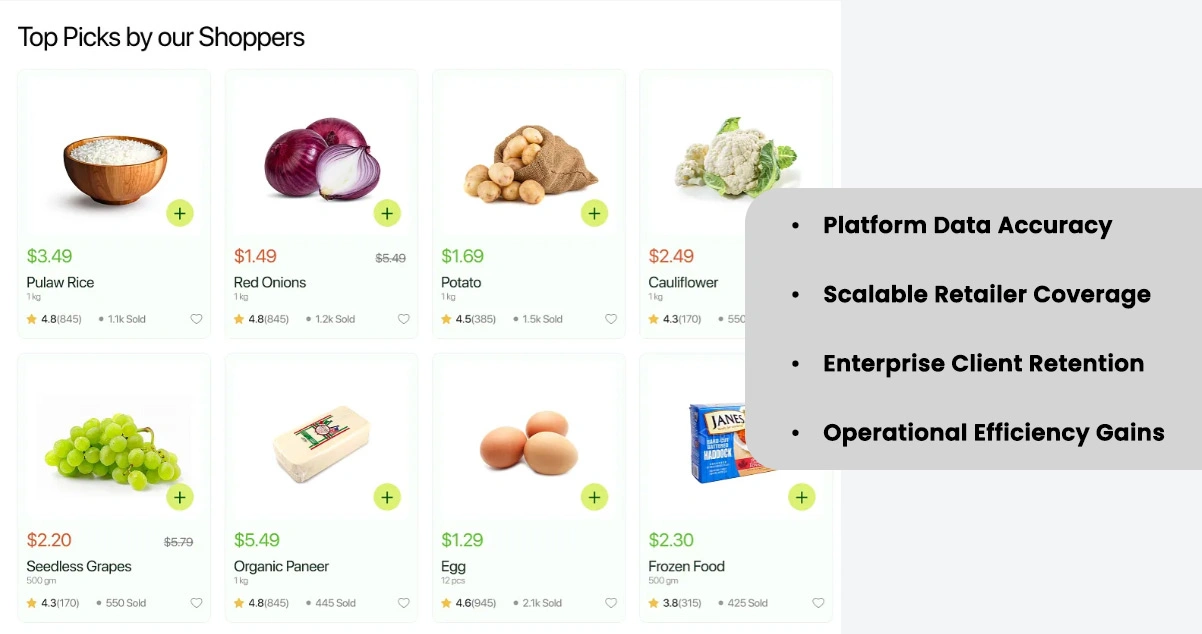
The implemented solution delivered measurable improvements across the client's platform performance, data reliability, and business competitiveness.
- Platform Data Accuracy
Following deployment, the client's grocery comparison platform achieved significantly higher data freshness rates, with product pricing updated at intervals that aligned with actual in-store and online changes directly improving user trust and session engagement metrics across all supported retail chains. - Scalable Retailer Coverage
Using the modular extraction framework, the client onboarded twelve additional grocery chains within the first quarter post-launch, a process that previously would have required months of custom development. Grocery Price Tracking App Using Web Scraping functionality was extended to each new retailer within days of integration initiation. - Enterprise Client Retention
Enterprise clients relying on the platform for procurement benchmarking reported stronger satisfaction scores following the infrastructure upgrade, citing improved data consistency and more reliable Grocery Price Comparison API for Businesses outputs as primary drivers of their continued partnership. - Operational Efficiency Gains
Internal development resources previously tied up in scraper maintenance were redirected toward product feature development, as the self-healing extraction system dramatically reduced the frequency and severity of data pipeline incidents requiring manual resolution.
Key Highlights
- Precision at Scale
Our infrastructure enables businesses to Collect Grocery Product Prices Using Web Scraping APIs across hundreds of store categories simultaneously, with normalized outputs ready for immediate integration into comparison platforms, analytics dashboards, or retail strategy tools. - Live Market Visibility
Continuous extraction cycles power Grocery Price Monitoring Using Web Scraping capabilities that give businesses a real-time window into competitor pricing moves, promotional activity, and product availability changes across all monitored retail environments. - Flexible API Integration
The solution's output layer is structured for seamless connection with existing business systems, enabling Grocery Price Comparison API for Businesses delivery through standardized endpoints that minimize integration complexity for enterprise development teams.
Use Cases
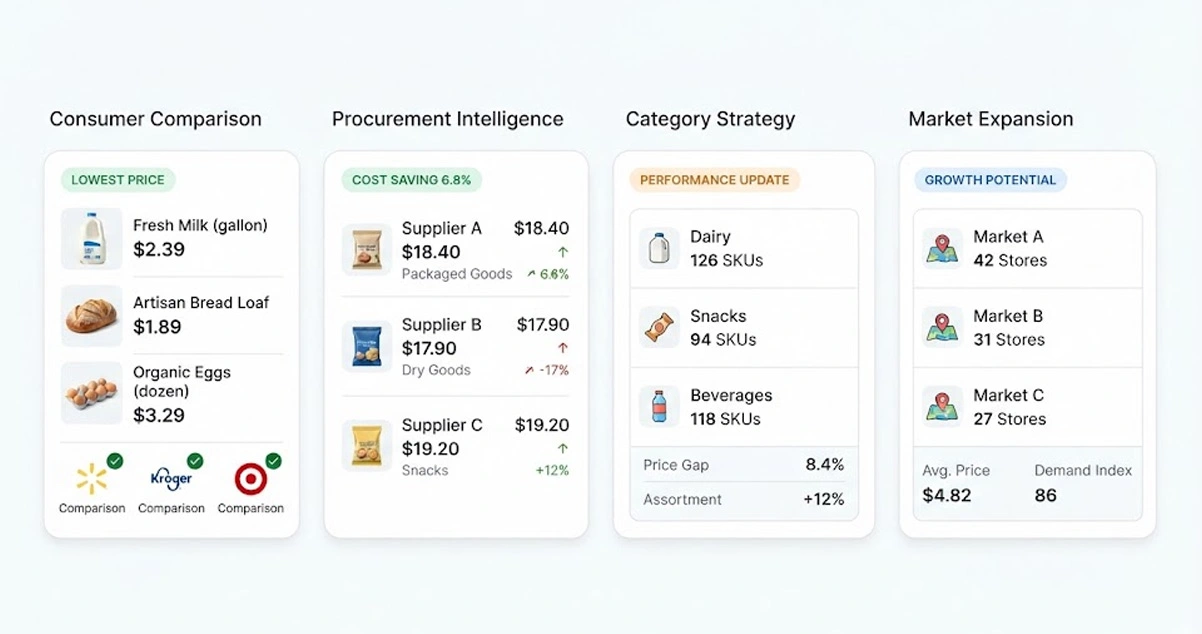
Our grocery data extraction capabilities support a wide range of strategic applications across retail, analytics, and product development functions.
- Consumer Comparison Platform Enhancement
Platform teams can power accurate, real-time price comparison features by integrating structured grocery data directly into their frontend and backend systems, enabling users to make informed purchasing decisions based on current, verified product pricing across multiple retail chains. - Enterprise Procurement Intelligence
Procurement and supply chain teams use API Scraping pipelines to continuously monitor input costs and vendor pricing across grocery supplier ecosystems, enabling faster contract renegotiation, smarter bulk purchasing decisions, and more precise budget forecasting at both regional and national scale. - Retail Category Strategy
Category managers and merchandising teams apply Grocery Product Catalog Scraping for Market Analysis to evaluate competitor assortment depth, identify pricing gaps, and adjust product positioning strategies in response to observed market behavior all grounded in consistently refreshed, verified data. - New Market Expansion Planning
Business development teams use extracted grocery datasets to assess pricing norms, consumer demand signals, and competitive density in target markets before committing to expansion investments reducing risk and improving the accuracy of go-to-market forecasting models.
Client's Testimonial

Working with the Mobile App Scraping team fundamentally changed how we approach pricing intelligence. Before this engagement, our platform struggled with stale data and constant pipeline failures. Grocery Price Data Extraction Using Web Scraping APIs is now the backbone of everything we build. The speed and reliability of Grocery Price Tracking App Using Web Scraping features on our platform have genuinely impressed our enterprise clients and strengthened our market position considerably.
– Marcus Delaney, Head of Product, Digital Retail Analytics Platform
Conclusion
The grocery retail landscape rewards businesses that act on accurate, timely data and those without it consistently find themselves reacting rather than leading. Grocery Price Data Extraction Using Web Scraping APIs is no longer a technical advantage reserved for large enterprises; it is a baseline requirement for any business serious about competing in modern grocery comparison and retail analytics.
Grocery Product Catalog Scraping for Market Analysis equips teams with the depth of product-level intelligence needed to make confident decisions across pricing, assortment, and market expansion turning raw data into a consistent strategic edge. Contact Mobile App Scraping today to learn how our purpose-built grocery data extraction solutions can power your comparison platform, support your analytics team, and give your business the market intelligence foundation it needs to grow.