Introduction
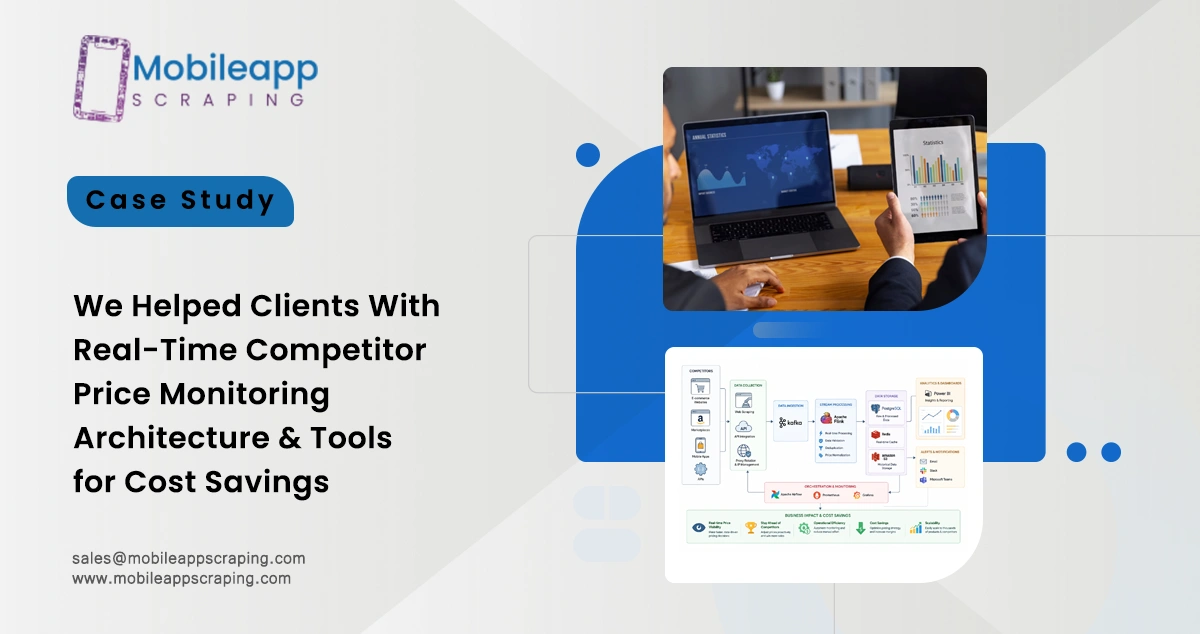
In the rapidly evolving e-commerce landscape, pricing decisions made without reliable market context can erode margins and weaken competitive positioning almost overnight. Businesses that depend on outdated or incomplete pricing data consistently fall behind rivals who respond faster to shifting market conditions. This is precisely where Real-Time Competitor Price Monitoring: Architecture & Tools becomes an indispensable capability for any growth-focused brand.
Our engagement with a global e-commerce leader demonstrated how structured data acquisition frameworks can transform the way organizations approach pricing strategy. Through Web Scraping for Price Monitoring for Business Insights, the client was able to replace gut-based decisions with intelligence-backed approaches that produced measurable improvements across product categories and regional markets.
Partnering with our team also gave the client access to Competitive Benchmarking Services that surfaced competitor behavior at scale, enabling leadership to act on real pricing signals rather than assumptions. The combination of technical architecture and strategic methodology created a foundation for sustainable cost savings and long-term pricing excellence.
The Client
A large-scale global e-commerce retailer operating across multiple verticals and geographies approached us with a clear mandate: build a pricing intelligence system capable of operating continuously across thousands of SKUs and dozens of competitor platforms. The client had an established customer base but lacked the internal infrastructure to monitor external pricing movements with any degree of consistency or precision.
Their merchandising and category management teams relied heavily on periodic manual surveys to understand competitor pricing, a process that was slow, resource-intensive, and prone to significant error. This limited visibility left the pricing team reacting to market changes rather than anticipating them. The organization recognized that Real-Time Competitor Price Monitoring: Architecture & Tools was no longer a competitive advantage but a basic operational necessity.
To move forward effectively, the client needed a scalable, automated solution built on solid data engineering principles. By deploying Web Scraping Architecture for Competitor Price Monitoring, they aimed to eliminate blind spots, standardize data flows across geographies, and empower their commercial teams with the kind of granular, timely intelligence required to make confident pricing decisions every single day.
The Challenge
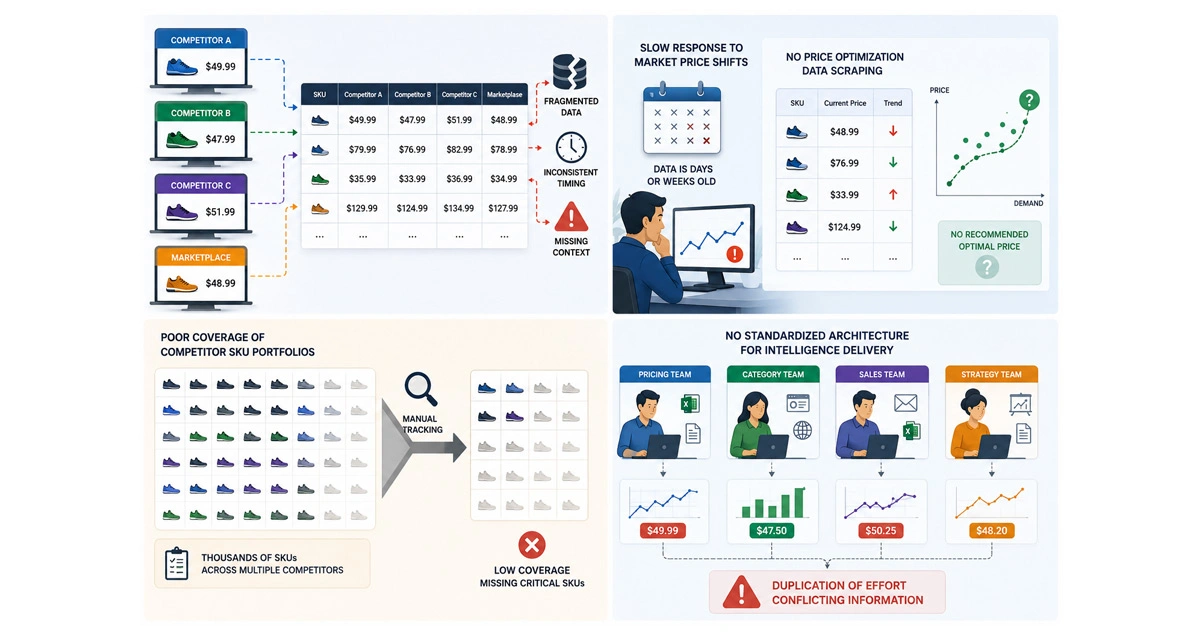
The client operated in a high-velocity retail environment where price changes from key competitors could occur multiple times within a single day. Their existing processes were wholly inadequate for this pace, leading to a series of compounding operational and strategic challenges.
- Fragmented Pricing Data Across Channels: This made it nearly impossible to apply Extract SKU-Level Price Monitoring for Competitor Analysis at the granularity needed to drive category-level decisions with confidence.
- Slow Response to Market Price Shifts: Without a real-time data pipeline, the team was consistently working with information that was days or even weeks old. The absence of Price Optimization Data Scraping meant the client lacked the tools to model optimal price points before acting.
- Poor Coverage of Competitor SKU Portfolios: The sheer volume of SKUs across multiple competitor platforms meant that manual tracking efforts captured only a fraction of the relevant market.
- No Standardized Architecture for Intelligence Delivery: Each team within the organization had developed its own informal methods for gathering competitive data, leading to duplication of effort and conflicting information.
The Solution
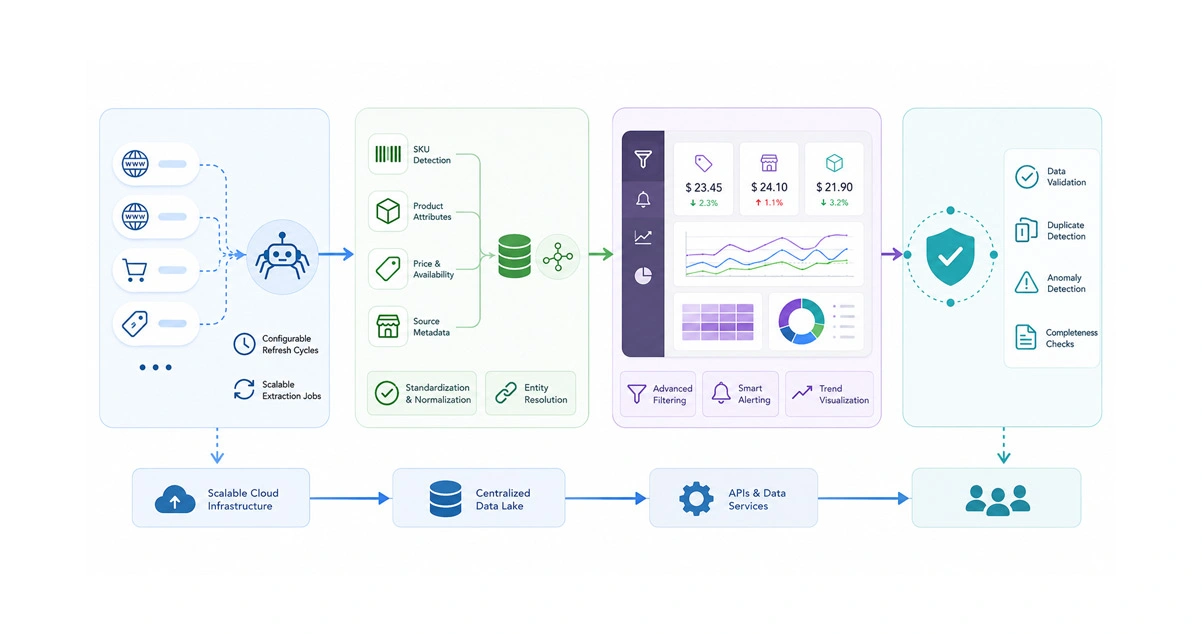
We designed a comprehensive, modular data infrastructure tailored specifically to address the client's pricing intelligence gaps. Each component of the solution was built for scalability, reliability, and precision.
- Market Signal Aggregator
This system enabled Competitive Price Intelligence Through Automated Web Scraping by running structured extraction jobs across dozens of domains on configurable refresh cycles tied to market activity patterns. - SKU Mapping and Normalization Layer
Powered by Price Monitoring Services, this layer ensured that each data point was correctly attributed, enriched with metadata, and made immediately usable by downstream analytics teams. - Dynamic Pricing Intelligence Dashboard
Intuitive filtering, alerting, and trend visualization tools enabled teams to monitor competitor behavior and identify pricing opportunities without requiring technical expertise. - Automated Validation and Quality Control Engine
Every data record passing through the pipeline was subjected to rigorous validation checks designed to flag anomalies, duplicates, and incomplete entries before they reached end users.
Implementation Process
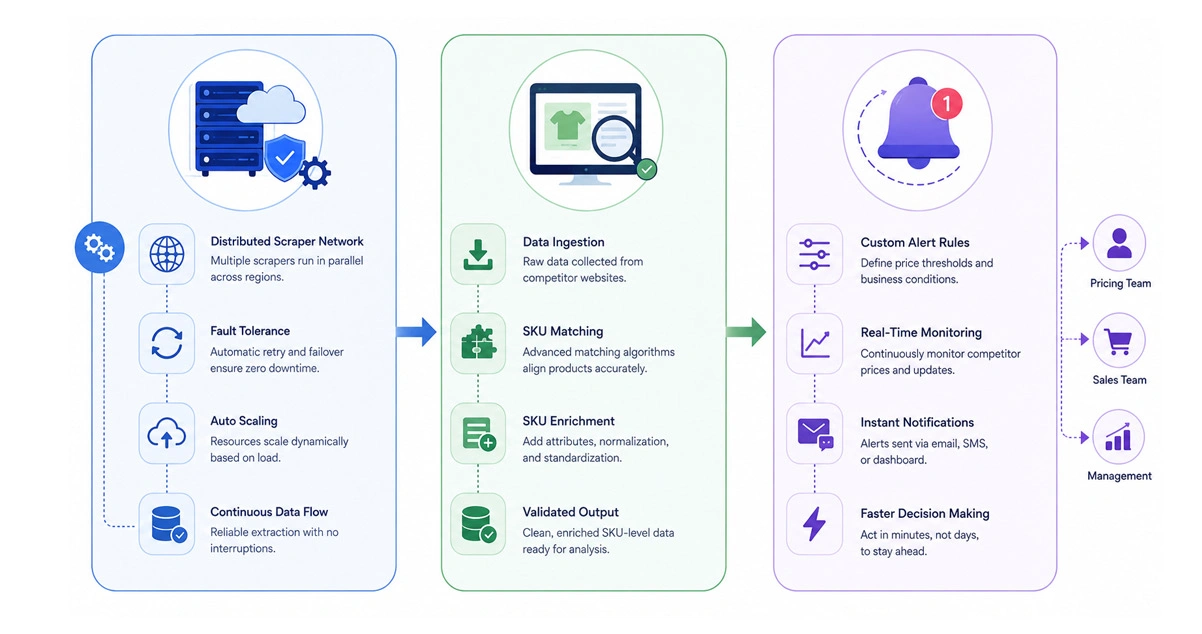
The delivery was structured in clearly defined phases to ensure system stability, stakeholder alignment, and iterative refinement throughout the engagement.
- Scalable Extraction Infrastructure SetupThe architecture supporting Web Scraping Architecture for Competitor Price Monitoring was designed with fault tolerance and automatic failover at every layer to guarantee continuous data flow without disruption.
- Catalog Alignment and SKU Enrichment PipelineThis pipeline used Extract SKU-Level Price Monitoring for Competitor Analysis methodologies to ensure product matching was precise enough to support item-level pricing decisions rather than broad category estimates.
- Real-Time Alert and Notification SystemCustom alert rules were configured to notify relevant stakeholders whenever competitor prices crossed defined thresholds, enabling rapid commercial response. This component directly translated intelligence into action by reducing the time between data availability and pricing decision from days to minutes.
Results & Impact
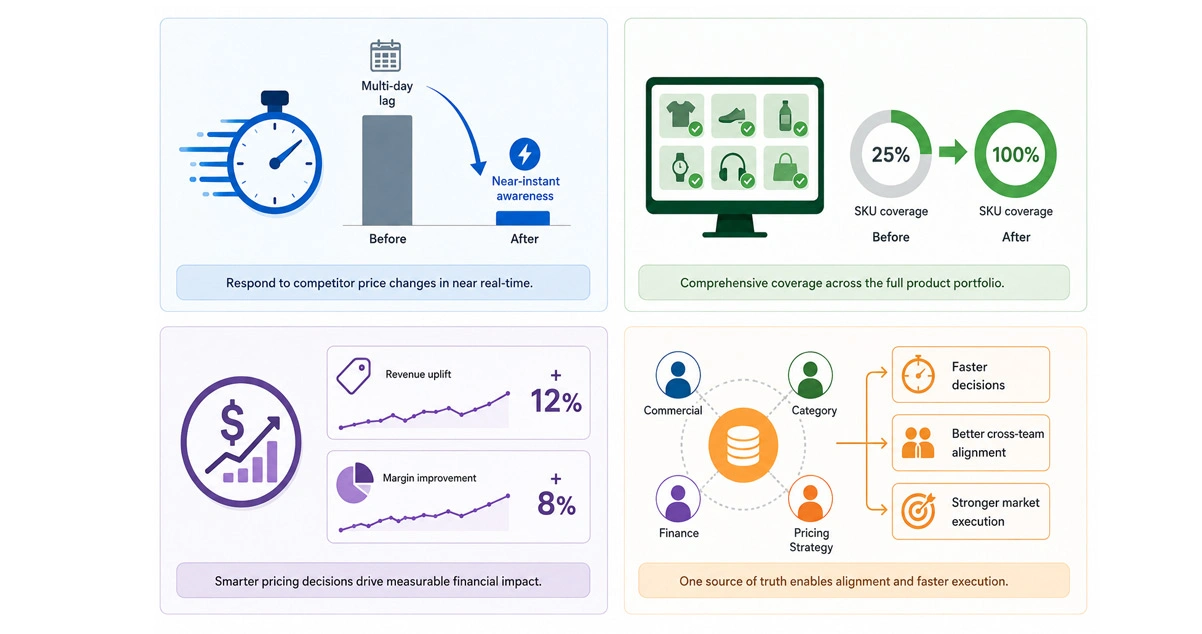
The deployment delivered substantial, measurable improvements across pricing performance, operational efficiency, and strategic decision-making speed.
- Pricing Response Time Reduction
The client reduced its average response time to competitor price changes by a significant margin, moving from multi-day lag times to near-instant awareness. This agility directly contributed to defending market share during high-traffic promotional periods and seasonal demand surges. - SKU Coverage Expansion
Where manual processes previously captured a limited percentage of competitor catalog movements, the automated system now provided comprehensive coverage across the full portfolio. Teams could finally apply Competitive Price Intelligence Through Automated Web Scraping to every relevant product line, not just the top sellers. - Measurable Cost Savings Through Smarter Pricing
With accurate, real-time market data driving pricing adjustments, the client identified multiple categories where it had been systematically underpricing relative to competitors or overpricing against the market. Correcting these patterns generated tangible revenue uplift and margin improvement within the first quarter of operation. - Cross-Team Alignment on Pricing Strategy
A single source of truth for competitive pricing data eliminated the internal conflicts and duplicated efforts that had previously slowed decision-making. Commercial, category, and finance teams now operated from a unified intelligence platform, resulting in faster consensus and more cohesive market strategy execution.
Key Highlights
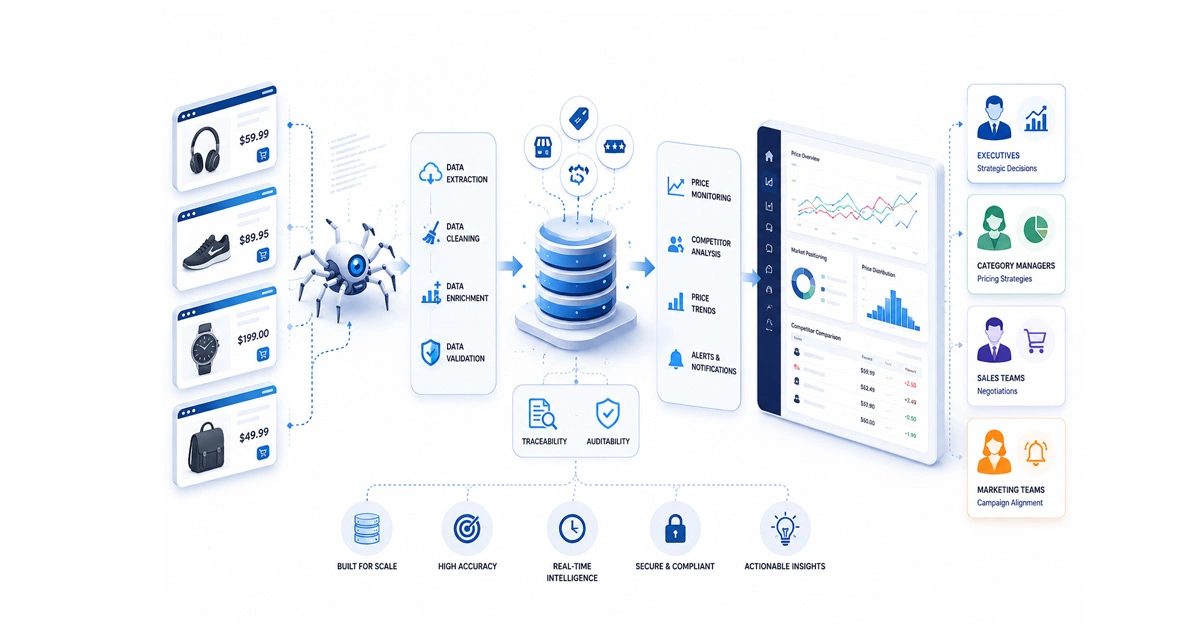
- Architecture Built for Scale and Precision
Real-Time Competitor Price Monitoring: Architecture & Tools formed the backbone of a system that expanded the client's intelligence capabilities far beyond what any manual approach could achieve. - End-to-End Pricing Visibility
Every stage of the data journey, from extraction to enrichment to visualization, was designed to maintain full traceability and auditability. Web Scraping for Price Monitoring for Business Insights became a fully integrated business function rather than a one-off analytical exercise. - Actionable Intelligence at Every Level
Competitive Price Intelligence Through Automated Web Scraping empowered every stakeholder with the specific context needed to act decisively and confidently.
Use Cases
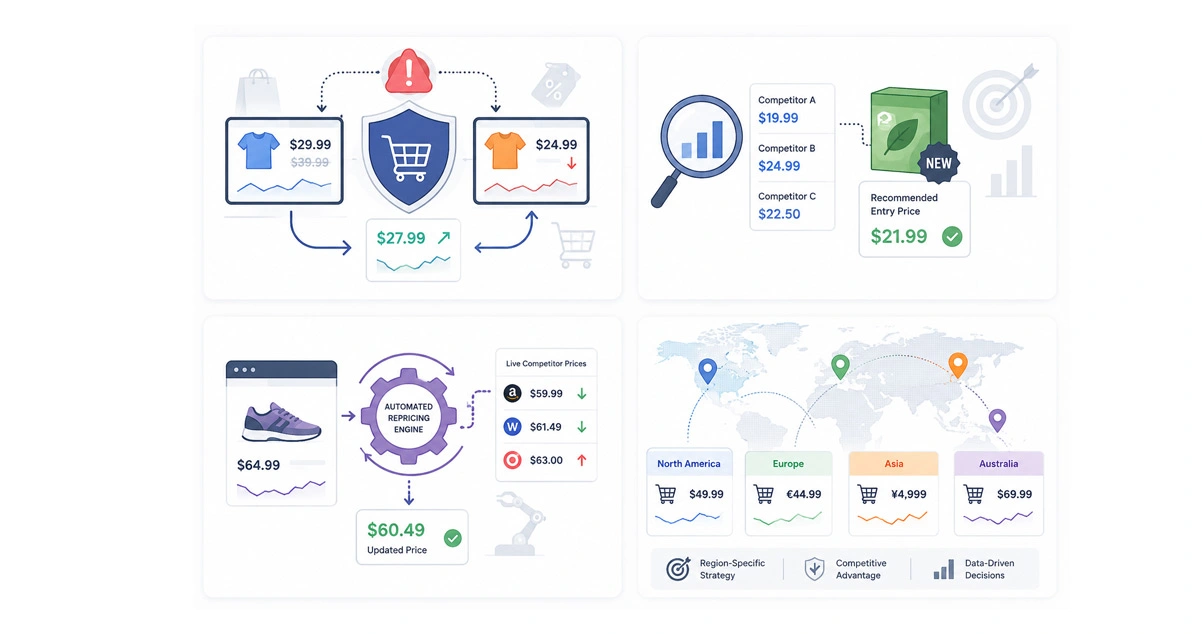
Organizations across e-commerce, retail, and consumer goods can apply this framework to address a wide range of competitive intelligence needs.
- Promotional Period Defense
Retail Strategy teams can use continuous competitor price tracking to protect market share during high-stakes sales windows by identifying aggressive promotional moves early and responding with precisely calibrated counter-strategies. - Category Expansion Planning
New Market Entry teams benefit from Pricing Intelligence Data Scraping to evaluate the competitive pricing landscape before launching new product lines, ensuring entry price points are positioned effectively relative to established market players. - Dynamic Repricing Automation
Pricing Operations teams can feed real-time competitor data directly into automated repricing engines, allowing the system to adjust prices algorithmically based on live market signals without requiring manual intervention at the SKU level. - Regional Pricing Strategy Development
Regional Commercial teams gain the granular, location-specific competitor data needed to build differentiated pricing strategies for distinct geographies. Web Scraping Architecture for Competitor Price Monitoring supports this by delivering regionally segmented intelligence with consistent accuracy.
Client’s Testimonial

Partnering with Mobile App Scraping fundamentally changed how we approach competitive pricing. The depth and reliability of intelligence delivered through Real-Time Competitor Price Monitoring: Architecture & Tools gave our teams the confidence to make faster, better-informed decisions. Our ability to Web Scraping for Price Monitoring for Business Insights at this scale was something we genuinely did not think was achievable within our existing operational framework.
– Mark Delray, Vice President of Commercial Strategy
Conclusion
Pricing strategy without reliable competitive intelligence is essentially navigation without a map. Real-Time Competitor Price Monitoring: Architecture & Tools is no longer a luxury reserved for the largest players; it is a foundational capability that businesses of all scales must build and maintain to stay commercially relevant.
The results this client achieved demonstrate what becomes possible when intelligent architecture meets precise execution. Extract SKU-Level Price Monitoring for Competitor Analysis enables organizations to close the gap between data availability and decision-making speed, turning pricing from a periodic exercise into a continuous competitive advantage.
Contact Mobile App Scraping today to learn how our real-time pricing intelligence solutions can be tailored to your specific market, product portfolio, and competitive environment.