Introduction
The grocery retail sector is undergoing a fundamental shift, driven by the explosive growth of on-demand delivery platforms and increasingly complex supply chains. Real-Time Grocery Data Scraping From Delivery Apps has emerged as a transformative capability that allows businesses to monitor product availability, pricing fluctuations, and demand surges before they impact operations.
Meeting consumer expectations in quick commerce requires more than traditional inventory tools. The speed at which product listings change across multiple delivery platforms makes manual tracking practically impossible. Grocery App Data Extraction fills this gap by automating the collection of structured product and pricing data directly from live app environments, ensuring retailers always have access to the most current market signals.
Sustained success in grocery retail depends on the ability to respond quickly — not just to internal stock levels, but to what competitors are doing across digital storefronts. Real-Time Supermarket Inventory Data Extraction empowers merchandising teams with the kind of granular, up-to-date intelligence that transforms reactive restocking into proactive inventory planning and category-level strategy.
The Client
A mid-to-large regional grocery retail group with an established presence across both urban and semi-urban markets approached us with a clear objective: improve their inventory responsiveness on quick commerce platforms. How to Scrape Grocery Delivery App Pricing Data was a central concern for their technology and operations team, as real-time pricing intelligence had become inseparable from inventory strategy.
The client managed thousands of active SKUs across multiple delivery platforms, each with its own pricing logic and availability indicators. Coordinating that volume without centralized data infrastructure meant that stock-outs and price mismatches were quietly eroding customer satisfaction scores. Their leadership recognized that Quick Commerce Product Availability Monitoring Solutions were no longer a competitive edge but a baseline operational requirement for staying functional in the current delivery landscape.
To address these compounding challenges, the client sought a scalable, automated data solution that could support weekly planning cycles, promotional pricing decisions, and regional assortment adjustments simultaneously. Web Scraping Grocery Delivery Apps for Retail Intelligence was identified as the foundational capability that would tie together their inventory, pricing, and fulfillment workflows into one coherent data-driven operation.
The Challenge
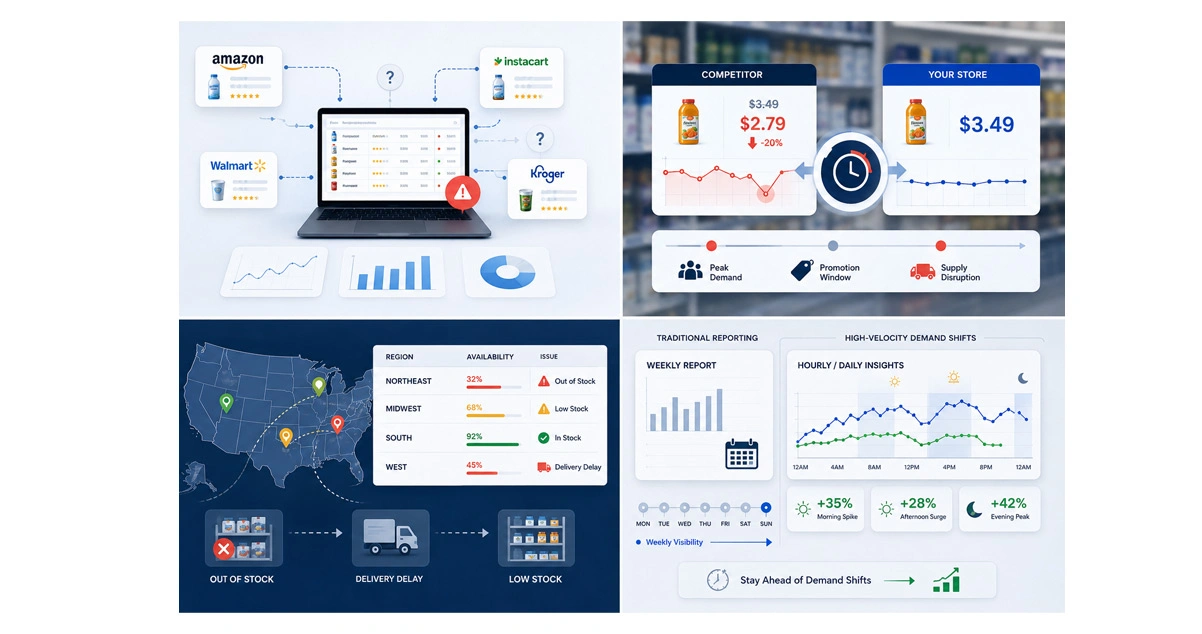
The client encountered several compounding operational and strategic problems that traditional systems were simply not equipped to solve.
- Fragmented Product Visibility Across Platforms
The absence of Grocery Supermarkets Store Datasets that unified these fragmented signals meant that category managers were often working with outdated or incomplete information when making restocking and assortment decisions. - Delayed Pricing Response in Competitive Windows
Competitors adjusted pricing frequently during peak demand periods, promotional windows, and supply disruptions but the client had no mechanism to detect these changes in real time. - Inconsistent Availability Tracking Across Regions
Without automated Real-Time Supermarket Inventory Data Extraction, regional operations teams could not distinguish between these causes quickly enough to take corrective action before customer churn occurred. - Inability to Anticipate Demand Pattern Shifts
The client's existing tools were built for weekly reporting cycles, not for tracking hourly or daily shifts in category-level demand leaving them consistently behind in planning for high-velocity product segments.
The Solution
We designed and deployed an integrated data infrastructure built around the specific dynamics of grocery delivery app ecosystems, addressing each of the client's core pain points with purpose-built components.
- StockPulse Intelligence Layer
This system provided the backbone for How to Scrape Grocery Delivery App Pricing Data at scale, allowing the client to access clean, category-organized data feeds without manual intervention or platform-specific workarounds. - Quick Commerce Data Extraction
A specialized Quick Commerce App Data Extraction module was developed specifically for quick commerce platforms, where product states availability, pricing, promotional tagging can change multiple times within a single day. - DemandSignal Forecasting Framework
By applying machine learning models trained on historical delivery app data, the framework allowed the client's planning teams to anticipate inventory requirements rather than react to them after stock-outs had already occurred. - Regional Assortment Optimization Engine
This gave regional buyers and category managers the ability to tailor assortments and safety stock levels based on neighborhood-level demand dynamics, reducing overstock in slow zones and minimizing shortfalls in high-demand corridors.
Implementation Process

The deployment was structured into phased stages, ensuring each component was stable and producing validated outputs before the next was activated.
- Unified Data Ingestion Architecture
Web Scraping Grocery Delivery Apps for Retail Intelligence required handling different data formats, rendering environments, and update frequencies — all of which were normalized within this architecture before being passed downstream for processing. - Structured Validation and Quality Pipeline
Anomalies such as sudden price spikes, missing availability flags, or duplicate SKU records were flagged automatically and routed for human review, ensuring that Real-Time Grocery Data Scraping From Delivery Apps delivered data that teams could trust for critical decisions. - Operational Dashboard and Alerting System
A reporting interface was built to surface inventory and pricing signals in formats matched to each stakeholder group from logistics coordinators needing availability heat maps to category managers reviewing competitive pricing ladders.
Results & Impact

The deployment produced measurable improvements across inventory performance, pricing responsiveness, and regional planning accuracy within the first quarter of full operation.
- Inventory Accuracy Uplift
By maintaining continuous data flows through Quick Commerce Product Availability Monitoring Solutions, the client reduced stock discrepancy rates across monitored platforms by a significant margin, giving operations teams reliable daily snapshots of actual product availability rather than estimates derived from stale system records. - Faster Competitive Pricing Response
How to Scrape Grocery Delivery App Pricing Data gave the client a structural advantage in promotional planning by eliminating the delay between market movement and internal response. - Improved Regional Replenishment Planning
This reduced both overstock situations in lower-demand zones and fulfillment failures in high-velocity urban corridors, directly improving delivery fulfillment rates and customer satisfaction scores. - Stronger Category-Level Demand Forecasting
Real-Time Supermarket Inventory Data Extraction provided the continuous data foundation that transformed forecasting from a periodic estimate into an ongoing, adaptive process.
Key Highlights
- Scalable Data Infrastructure
Delivers continuous, structured market intelligence by processing product, pricing, and availability data from delivery platforms at volume, supporting inventory and category planning decisions with reliable, high-frequency data outputs through Web Scraping Grocery Delivery Apps for Retail Intelligence. - Pricing Intelligence in Real Time
Supports competitive responsiveness by detecting pricing movements on monitored platforms as they occur, equipping merchandising teams with timely signals for adjustments during promotional periods, demand peaks, and supply-side disruptions through Real-Time Grocery Data Scraping From Delivery Apps. - Hyperlocal Assortment Visibility
Enables location-aware inventory planning by separating regional demand signals from aggregated market data, allowing category managers to make assortment and stocking decisions that reflect the specific purchasing behaviors of individual delivery zones through Quick Commerce Product Availability Monitoring Solutions.
Use Cases
- Stock Availability Monitoring for Fulfillment Teams
Operational Planning Support equips fulfillment coordinators with real-time product availability data across delivery platforms, reducing instances of unfulfillable orders and enabling proactive communication with suppliers before stock-out conditions affect customer-facing listings. - Price Comparison Services
Competitive Pricing Analysis provides category managers and pricing strategists with structured comparative data across delivery app storefronts, enabling informed pricing decisions that account for competitor positioning. Price Comparison Services built on this data layer help teams identify gaps, opportunities, and risks within current pricing architecture before they impact revenue performance. - Demand Trend Analysis for Buying Teams
Category Performance Intelligence enables buying teams to monitor shifts in product velocity across platforms and regions, using Real-Time Supermarket Inventory Data Extraction to identify which categories are gaining or losing traction so purchasing volumes can be adjusted before demand gaps or overstock conditions develop. - New Market Expansion Planning
Geographic Growth Strategy supports retail expansion decisions by providing data on product performance patterns in adjacent markets, helping strategy teams evaluate entry points, assortment requirements, and competitive dynamics before committing capital to new delivery zone activations.
Client’s Testimonial

The impact of integrating Real-Time Grocery Data Scraping From Delivery Apps into our operations has been substantial and immediate. The Mobile App Scraping solution now has a level of pricing and availability visibility that was simply not achievable with our previous tools. The How to Scrape Grocery Delivery App Pricing Data capability has been particularly valuable during promotional windows, where timing and accuracy make the difference between a successful campaign and a missed opportunity.
– Marcus Ellroy, VP of Supply Chain and Inventory Strategy
Conclusion
The grocery retail landscape is moving faster than conventional inventory systems were designed to handle, and businesses that rely on periodic data snapshots are increasingly exposed to stock-out risks, pricing misalignment, and demand forecasting failures. Real-Time Grocery Data Scraping From Delivery Apps addresses these vulnerabilities at their root by replacing delayed, fragmented data flows with continuous, structured intelligence drawn directly from the platforms where consumers are making purchasing decisions.
Contact Mobile App Scraping today to find out how our specialized grocery data extraction services can transform your inventory planning, pricing strategy, and regional fulfillment operations. Web Scraping Grocery Delivery Apps for Retail Intelligence provides the kind of market visibility that turns reactive supply chain management into a proactive, precision-driven capability aligned with both current demand and future growth.