

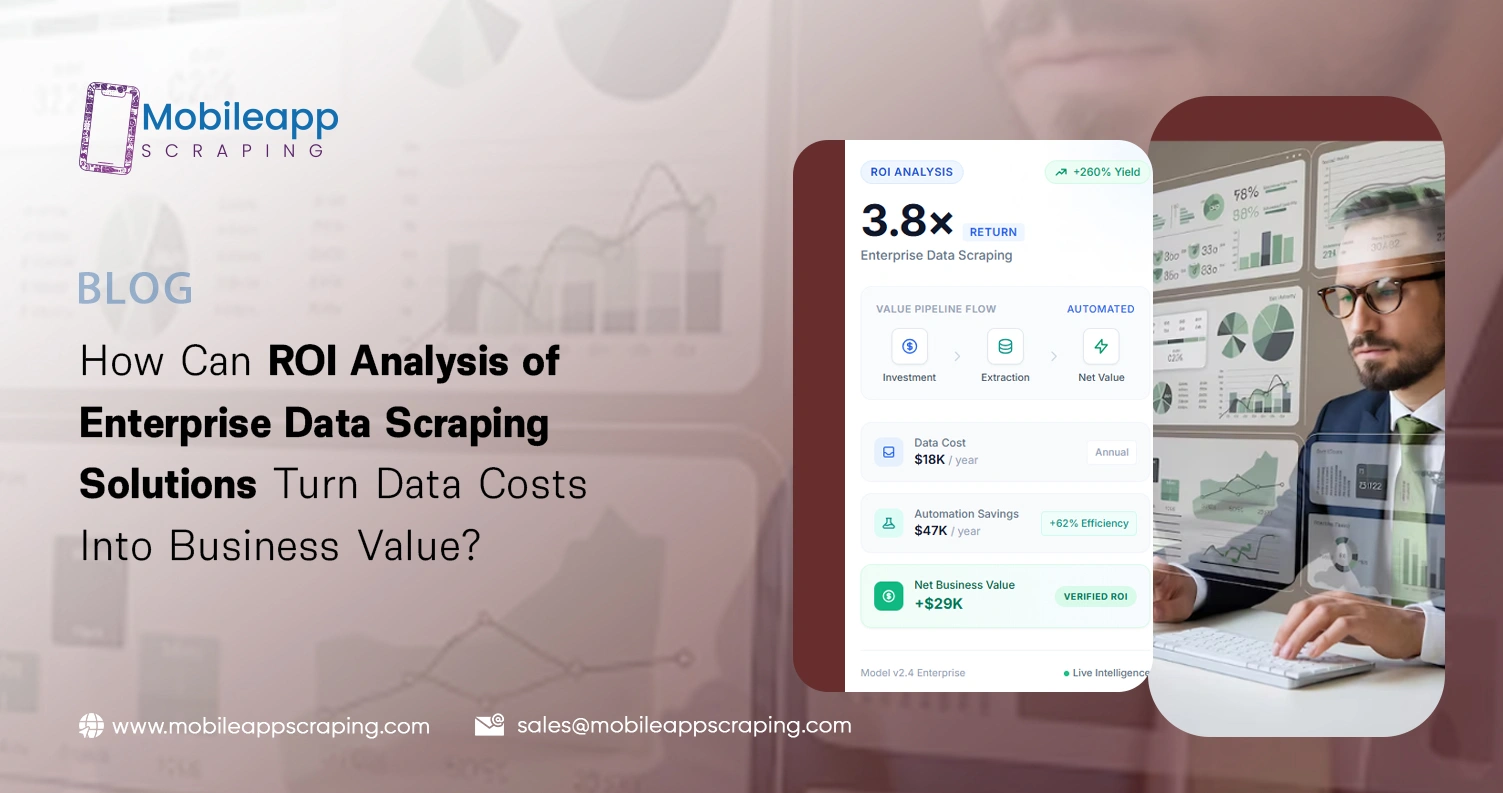
How Can ROI Analysis of Enterprise Data Scraping Solutions Turn Data Costs Into Business Value?
Introduction
Enterprise businesses increasingly rely on external data to evaluate competitors, monitor markets, track pricing, and support strategic decisions. However, collecting large volumes of information manually can create rising operational expenses. Enterprise App Crawling provides organizations with structured access to app-based information while supporting faster, more consistent data collection across multiple digital sources.
The challenge is no longer simply collecting information but determining whether the investment produces measurable business value. ROI Analysis of Enterprise Data Scraping Solutions helps companies compare technology expenses against measurable outcomes such as reduced research time, improved productivity, pricing opportunities, and faster decision-making.
A structured ROI approach also gives business leaders greater visibility into recurring scraping expenses, infrastructure requirements, maintenance efforts, and achievable returns. By connecting data collection with specific business objectives, enterprises can determine where automation creates meaningful value and where optimization can improve overall financial performance.
Connecting Automated Data Operations With Measurable Business Value
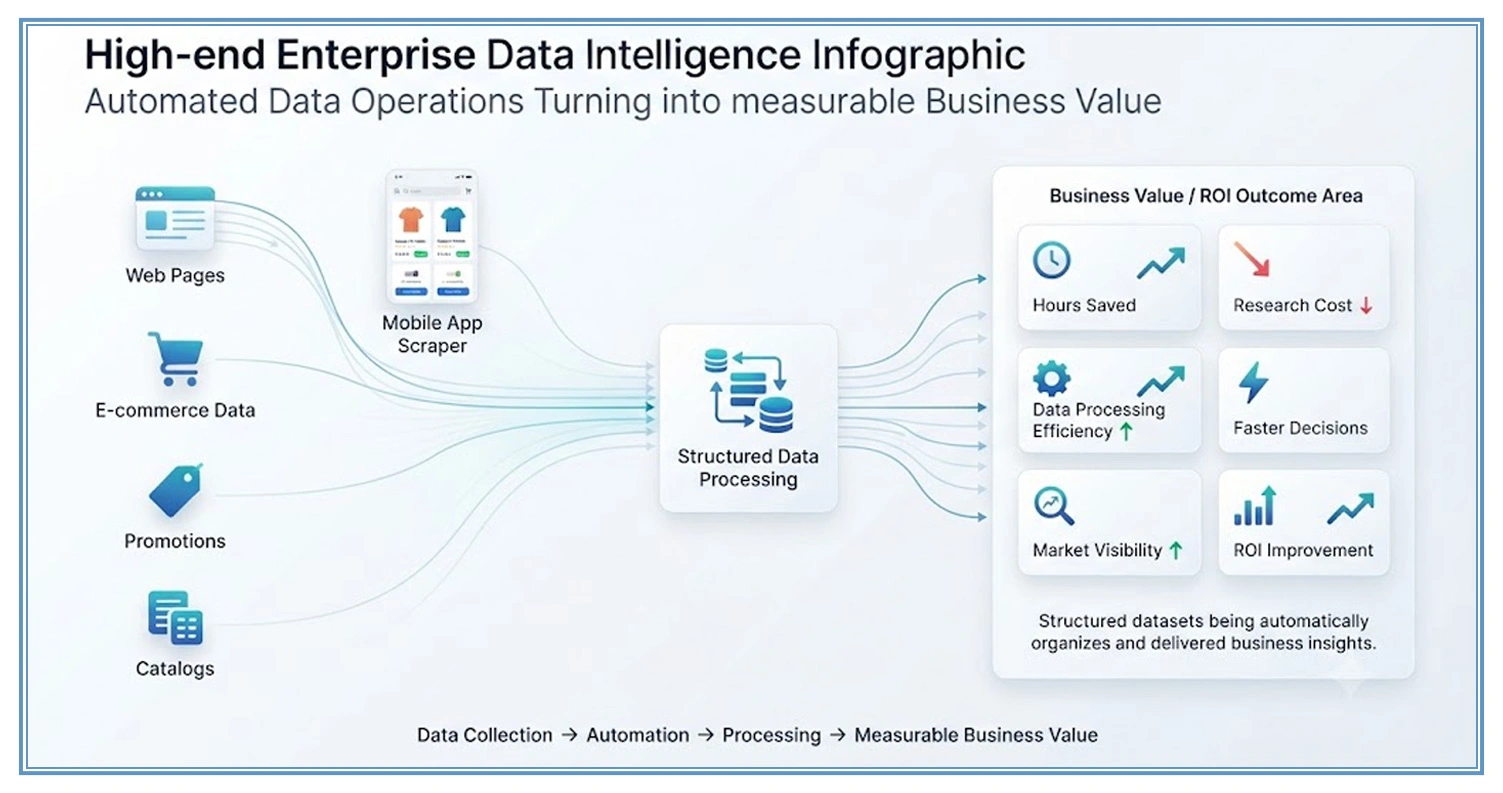
Enterprise data collection can influence productivity, research costs, market visibility, and decision-making speed. Businesses can assess these outcomes by comparing their existing manual workflows with automated processes and identifying where resources are being consumed unnecessarily. Return on Investment From Web Scraping Services becomes easier to evaluate when organizations measure savings alongside operational improvements rather than focusing only on technology expenditure.
A well-planned assessment can include employee hours, infrastructure expenses, maintenance requirements, data processing costs, and reporting efficiency. The Benefits of Investing in Web Scraping Services for Business can become more visible when collected information reaches analysts in structured formats without repeated manual preparation. This creates a practical connection between data operations and business performance.
Mobile applications can also contribute valuable information for organizations operating in competitive digital markets. Pricing, product availability, service information, promotional activity, and catalog changes can provide additional intelligence for commercial teams. A Mobile App Scraper can support recurring collection workflows, allowing businesses to organize application-based information alongside other external datasets.
Key areas to measure:
- Research hours reduced through automation
- Number of sources monitored consistently
- Frequency of data collection
- Time required for reporting
- Employee productivity improvements
Companies can strengthen their evaluation by tracking measurable indicators over defined periods. These indicators help management teams understand whether automation is improving productivity, expanding coverage, reducing repetitive activities, and supporting faster decisions. Regular measurement also makes it easier to identify underperforming workflows and allocate resources toward processes delivering stronger commercial outcomes.
| Measurement Area | Manual Workflow | Automated Workflow |
|---|---|---|
| Research Hours | Higher | Lower |
| Data Refresh | Periodic | Frequent |
| Processing Effort | Extensive | Reduced |
| Market Coverage | Limited | Broader |
| Reporting Speed | Slower | Faster |
Translating Data Collection Expenses Into Commercial Outcomes
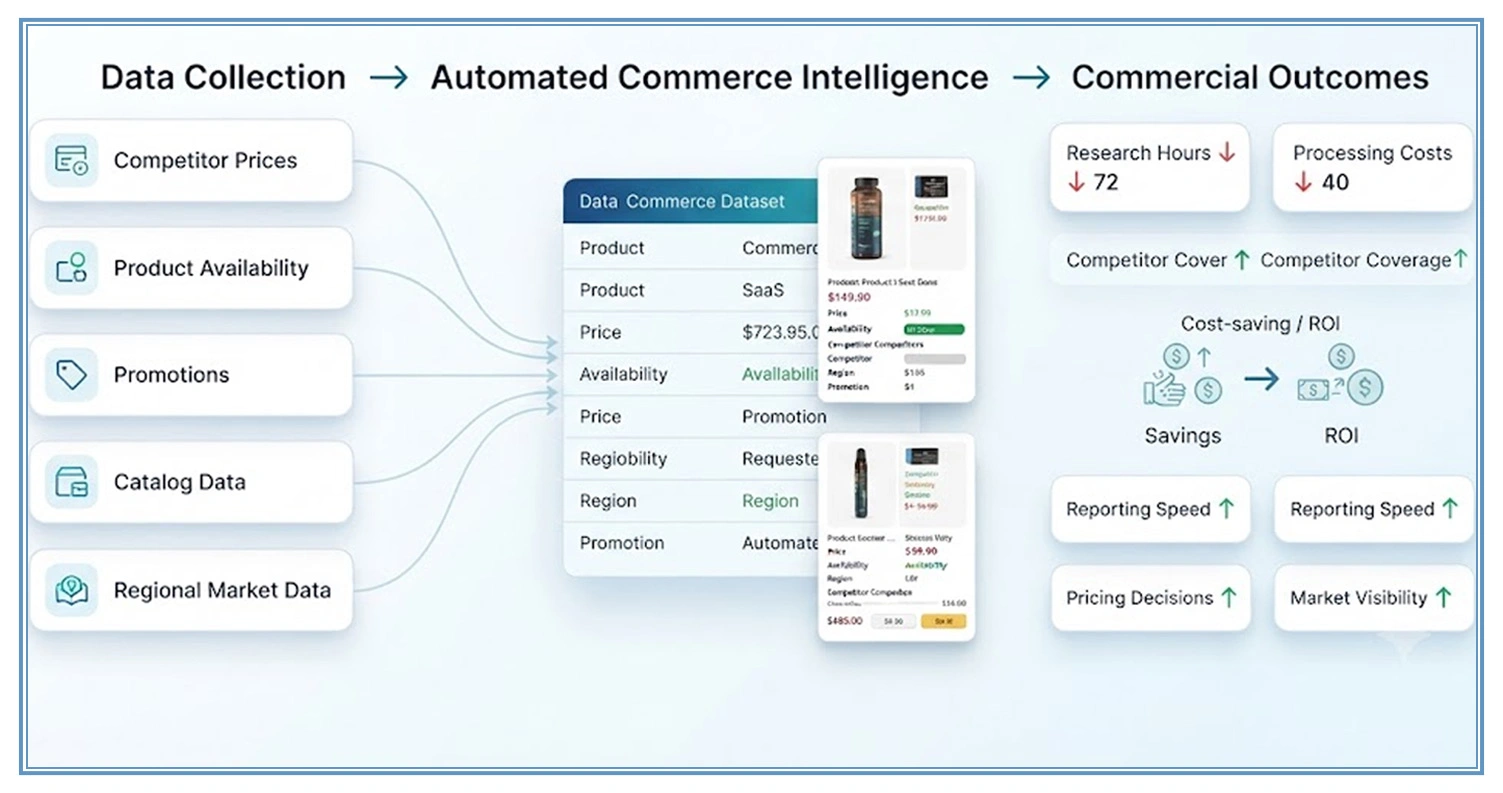
Data collection becomes financially meaningful when the information directly supports commercial activities such as pricing, assortment planning, competitor monitoring, and demand assessment. Businesses can identify measurable improvements by comparing previous operational expenses with the resources required after automation. This makes Cost Savings From Automated Web Scraping an important component of evaluating overall financial performance.
Organizations can also connect data availability with commercial decision-making. Structured information allows analysts to compare competitors, identify pricing movements, review product availability, and monitor changing market conditions without repeatedly collecting information manually. Commerce Intelligence Data Scraping can support these workflows by organizing product, pricing, promotional, and catalog information into datasets suitable for analysis.
The quality and frequency of data can influence how quickly teams respond to market changes. More consistent information can reduce delays between market movement and internal action, particularly for businesses managing large product portfolios or multiple geographic markets. When data reaches decision-makers in an organized format, teams can spend less time preparing information and more time interpreting commercial opportunities.
Important commercial indicators include:
- Competitor prices monitored regularly
- Product availability changes identified
- Market coverage across selected regions
- Reporting turnaround time
- Research resources required monthly
A practical evaluation should therefore consider both direct and indirect outcomes. Direct measurements can include reduced research hours and lower processing requirements, while indirect indicators may include faster reporting, improved pricing decisions, broader competitor coverage, and better planning. Reviewing these indicators regularly helps businesses understand how data infrastructure contributes to commercial performance over time.
| Business Indicator | Before Automation | After Automation |
|---|---|---|
| Competitor Tracking | Limited | Expanded |
| Price Monitoring | Periodic | Frequent |
| Data Preparation | Manual | Structured |
| Reporting Cycle | Longer | Shorter |
| Market Visibility | Moderate | Broader |
Building Long-Term Returns Through Scalable Data Infrastructure
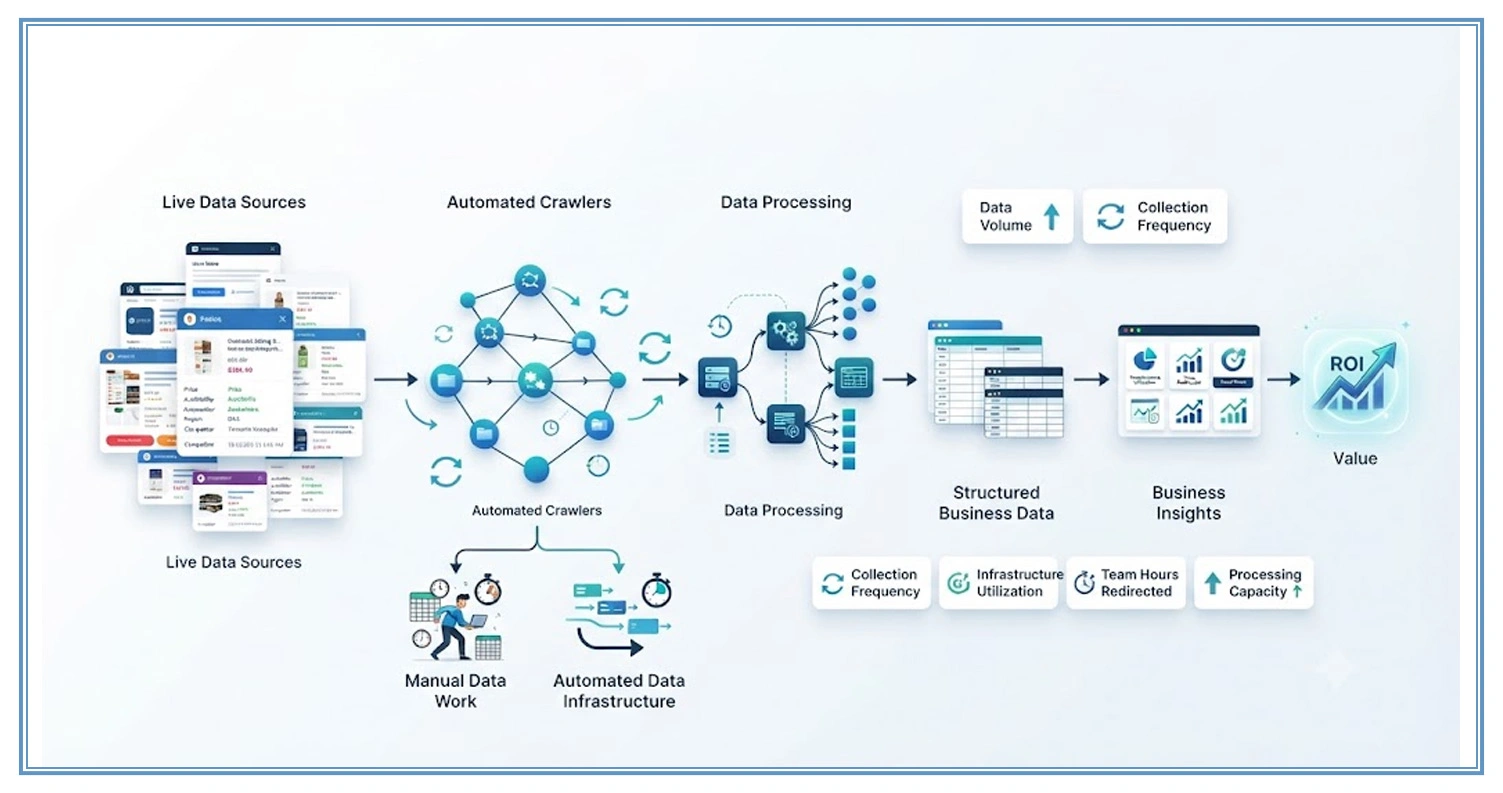
Long-term value depends on whether a scraping infrastructure can support growing data requirements without creating proportionally higher operating expenses. Enterprises should examine scalability, source coverage, maintenance requirements, processing capacity, and data delivery when evaluating technology investments. Business ROI Benefits of Automated Web Scraping can become more apparent when these operational improvements are measured consistently over time.
Continuous data availability can also improve how businesses respond to rapidly changing markets. Organizations monitoring prices, listings, availability, promotions, or competitor activity may require frequent updates rather than occasional research. Live Crawler Data Scraping can support recurring workflows where information needs to be collected and refreshed according to defined business requirements.
Another important consideration is workforce allocation. Automation can reduce the amount of time employees spend gathering, copying, cleaning, and organizing information. Instead, teams can focus on interpreting trends, developing strategies, validating findings, and making business decisions. This shift can create value beyond direct cost reduction by improving how specialized employees spend their working hours.
Long-term evaluation can include:
- Data volume processed over time
- Number of active sources
- Collection frequency and consistency
- Infrastructure utilization
- Team hours redirected toward analysis
Businesses can strengthen long-term performance by reviewing operational metrics regularly and adjusting their scraping architecture as requirements change. A scalable setup should accommodate additional sources, larger datasets, increased collection frequency, and evolving reporting requirements. This allows organizations to treat data collection as an adaptable business capability rather than a fixed technical expense.
| ROI Dimension | Initial Stage | Scaled Stage |
|---|---|---|
| Data Volume | Moderate | High |
| Source Coverage | Selected | Expanded |
| Collection Frequency | Periodic | Continuous |
| Processing Capacity | Basic | Scalable |
| Analytical Usage | Limited | Extensive |
How Mobile App Scraping Can Help You?
Businesses increasingly depend on mobile applications for product discovery, pricing, promotions, services, and customer engagement. When evaluating ROI Analysis of Enterprise Data Scraping Solutions, mobile sources can provide an additional layer of market intelligence that complements websites and other digital channels.
A Mobile App Scraper can collect structured information from selected applications according to defined business requirements.
- Monitor changing product and service information across applications.
- Track competitor pricing and promotional movements regularly.
- Organize app-based listings into structured business datasets.
- Compare regional availability and catalog differences efficiently.
- Support market research with recurring data collection.
- Reduce repetitive information gathering across multiple sources.
These capabilities can help organizations improve operational efficiency while creating a more consistent foundation for analysis. Web Scraping Automation for Reducing Labor Costs can further support teams by minimizing repetitive collection activities and allowing employees to focus on analysis, strategy, and decision-making.
Conclusion
Businesses need more than large datasets; they need measurable outcomes from every technology investment. By applying ROI Analysis of Enterprise Data Scraping Solutions, organizations can evaluate operational costs against productivity improvements, savings, data coverage, and commercial opportunities while identifying areas for better resource allocation.
A structured approach also clarifies where automation creates lasting financial value and how scraping programs can scale with changing business requirements. Scrape Investment for Competitive Market Analysis can strengthen market intelligence while supporting more informed strategic planning. Connect with Mobile App Scraping today and start measuring the business value of your data investment.