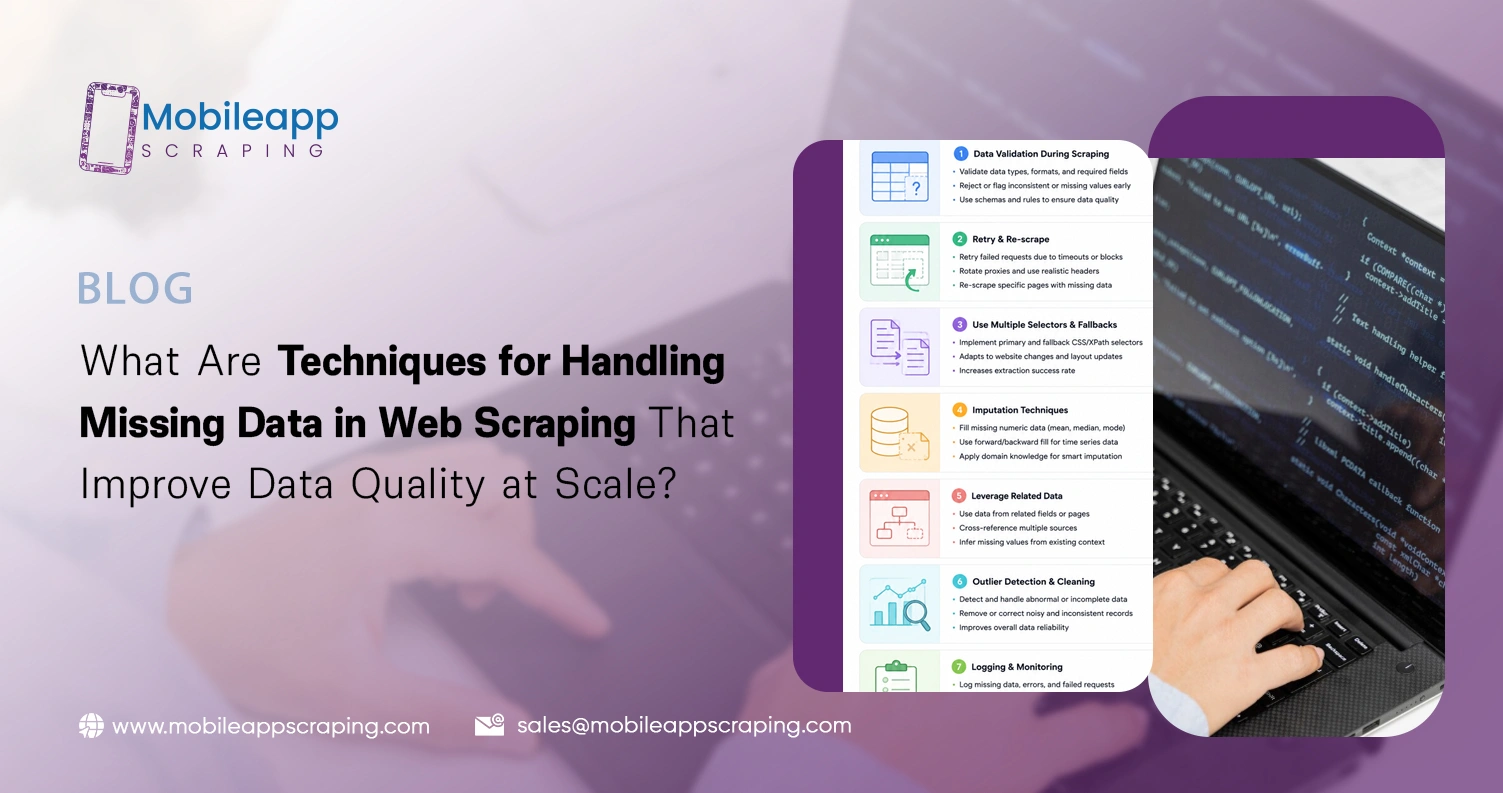
What Are Techniques for Handling Missing Data in Web Scraping That Improve Data Quality at Scale?
Introduction
Large-scale scraping projects often collect thousands of records from multiple sources, yet incomplete fields can reduce dataset reliability. Techniques for Handling Missing Data in Web Scraping help identify gaps, evaluate their causes, and establish practical recovery methods before incomplete information affects analytics, reporting, or business decisions.
Missing information may result from unavailable attributes, dynamic page elements, blocked requests, inconsistent website structures, or temporary extraction failures. With Enterprise Web Crawling, organizations can monitor collection patterns across numerous sources and identify recurring gaps while maintaining structured workflows for validation, normalization, and subsequent processing.
Effective handling requires more than simply deleting incomplete records. Teams should assess the importance of each field, determine whether values can be recovered, and apply suitable imputation or exclusion rules. This structured approach helps maintain consistency while supporting scalable datasets prepared for downstream analytical applications.
Strategic Precision: Identifying Data Gaps Across Large-Scale Scraping Workflows

Incomplete records can affect analysis when important attributes disappear during extraction. Missing product prices, ratings, categories, locations, or descriptions may result from changing page structures, unavailable elements, failed requests, or inconsistent source formatting. Web Scraping Services can also implement automated validation rules that flag unusual gaps during recurring extraction jobs.
A structured monitoring process can measure field-level completeness and highlight unusual changes across recurring extraction jobs. Missing Values in Scraped Data can be reviewed by calculating null percentages, comparing records between collection cycles, and checking whether specific sources consistently produce incomplete attributes.
Organizations can also compare incomplete records against historical outputs and related sources to understand whether the missing information is temporary or persistent. Field validation rules can flag unexpected gaps automatically, while source-level monitoring helps determine whether a particular website, application, or endpoint is responsible for declining completeness.
Practical identification methods include:
- Monitor completeness rates for every important field
- Compare current records with previous extraction cycles
- Flag sudden increases in incomplete attributes
- Separate technical failures from naturally unavailable information
- Prioritize high-value fields for additional verification
| Monitoring Area | Purpose |
|---|---|
| Field Completeness | Measures available attributes |
| Source Comparison | Detects collection inconsistencies |
| Historical Review | Identifies recurring gaps |
| Validation Rules | Flags unusual records |
| Error Tracking | Locates extraction failures |
Regular gap identification creates a reliable foundation for subsequent recovery. Instead of removing incomplete records immediately, teams can determine why information is absent and select an appropriate response. This approach reduces unnecessary data loss while supporting cleaner datasets across large-scale scraping workflows.
Smarter Recovery: Selecting Reliable Methods For Incomplete Scraped Records

After identifying incomplete records, the next step is selecting a recovery method appropriate to the missing field and its source. Some gaps occur because requests temporarily fail, while others result from dynamic elements, changed selectors, unavailable attributes, or inconsistent source structures.
Automated Missing Data Handling in Web Scraping can combine retry attempts, selector validation, alternate extraction paths, and historical comparisons to recover information systematically. A failed request may only require another attempt, whereas a permanently unavailable attribute may need controlled exclusion. Recovery rules should therefore consider the reliability, importance, and expected stability of every field.
Mobile applications can provide another useful reference when website records contain incomplete attributes. App Data Scraping Services can collect complementary information from application environments, allowing teams to compare prices, ratings, availability, product details, or other attributes.
Useful recovery practices include:
- Retry temporary request failures before marking fields missing
- Validate selectors after website structure changes
- Compare records against trusted historical datasets
- Cross-check important attributes across available sources
- Apply controlled exclusion when recovery is unsuitable
| Recovery Approach | Primary Application |
|---|---|
| Retry Process | Temporary extraction failures |
| Selector Validation | Structural changes |
| Historical Comparison | Stable attributes |
| Cross-Source Checking | Conflicting records |
| Controlled Exclusion | Unrecoverable fields |
Recovery should always preserve traceability. Teams can record which fields were recovered, which method was applied, and whether the replacement originated from another verified source. This creates a clearer quality-control process and helps prevent unsupported assumptions from entering production datasets.
Quality Continuity: Maintaining Consistent Accuracy Throughout Data Processing Pipelines

Data quality can decline even after missing records have been identified and corrected. Repeated extraction cycles may introduce new gaps because websites change layouts, APIs return different responses, or application interfaces modify available attributes. Continuous validation therefore helps ensure that recovered records remain consistent with the latest collection results and business requirements.
Best Techniques for Missing Data Imputation via Web Scraping can include rule-based replacement, historical estimation, statistical approaches, and carefully controlled exclusion. The selected method should depend on the field type and the reliability of available reference information. Highly variable attributes should not automatically receive historical values because outdated information can introduce new inaccuracies.
Standardized interfaces can also improve consistency across recurring extraction processes. Web Scraping API Services can help organizations maintain structured outputs, consistent field formats, and predictable validation checkpoints. When records pass through the same processing framework, teams can compare completeness and accuracy more effectively across different sources and collection periods.
A dependable quality framework can include:
- Validate recovered values before final processing
- Track field completeness after every extraction cycle
- Maintain records of recovery and modification activities
- Compare outputs across recurring collection periods
- Review unusual changes before dataset delivery
| Quality Check | Expected Outcome |
|---|---|
| Completeness Review | Fewer unexplained gaps |
| Value Validation | More reliable replacements |
| Format Checking | Consistent field structures |
| Historical Comparison | Detectable anomalies |
| Audit Tracking | Traceable processing |
Maintaining quality requires continuous oversight rather than a one-time cleanup exercise. Improving Data Quality in Large-Scale Scraping Pipelines becomes more practical when validation, recovery, monitoring, and audit processes operate together.
How Mobile App Scraping Can Help You?
Mobile applications often contain structured information that can complement datasets collected from traditional websites. Techniques for Handling Missing Data in Web Scraping become more effective when organizations compare information across multiple digital sources, helping identify whether a blank field represents genuine absence or an extraction limitation.
Key benefits of incorporating mobile application sources include:
- Comparing attributes across multiple collection channels
- Identifying inconsistent or incomplete records
- Supporting recurring data validation processes
- Tracking changes in field availability
- Improving source-level monitoring
- Creating structured datasets for downstream analysis
A coordinated workflow can combine application data with website records, historical information, and validation rules. This makes Handling Missing Fields in Web Scraped Data more systematic by providing additional reference points when primary sources contain incomplete attributes.
Conclusion
Reliable datasets depend on consistent identification, validation, and recovery of incomplete information. Techniques for Handling Missing Data in Web Scraping provide a structured way to evaluate gaps, select suitable recovery approaches, and maintain trustworthy records throughout large-scale extraction workflows.
Strong validation frameworks also support Improving Data Quality in Large-Scale Scraping Pipelines by monitoring completeness and documenting recovery decisions. Build cleaner, more reliable datasets with Mobile App Scraping solutions tailored to your data quality requirements.